painting tutorials, courses, tips & techniques

acrylic painting courses
Slide 1 learn to paint
will kemp art school
Learn to Paint
previous arrow
next arrow

The Practice That Can Quietly Slip Away
I have students who email me saying they’ve painted in the past, but are taking a break.

They still read and enjoy the tutorials, but don’t feel like they could give them a go. They don’t feel they could start again because they’re back at ground zero.

But I want you to know that hesitancy to start painting again has nothing to do with your skills.

You know how to mix colours, and you’ve got an empty canvas ready to go!

What’s gone is your belief that it’ll be good.

This January, I’ve had tons of household stuff to catch up on and new courses I’m researching, but alongside all that, I’ve been putting time aside to paint daily.

But what happens when the day doesn’t go to plan?

You miss one or two days, and it doesn’t change much.

But when you’ve missed a week, something begins to shift.

What about a month? A decade?

What I’ve discovered through my own practice is that the barrier to returning to painting isn’t lost skill—it’s lost confidence.

The Forgetting Curve and the Confidence Gap

We’ve previously looked at the forgetting curve, which shows us that we forget new knowledge at a surprisingly quick rate.

But this is something different.

The longer you wait, the more the psychological pressure builds.

It’s irrational.

Anxiety builds to such a point that it becomes a self-fulfilling prophecy.

The Procrastinating Painter

Timothy A. Pychyl, PhD, author of ‘Solving the Procrastination Puzzle’, is a procrastination researcher.

Through his research, he’s found that putting things off isn’t really about not having the time to do them, but about avoiding the perceived negative emotions that will come with the thing you’re procrastinating on.

“Procrastination isn’t a time management problem; it’s an emotional management problem. We have negative emotions attached to some tasks….we feel frustration, boredom, resentment or anxiety. By putting off the task, we put off those emotions, and that’s the crazy self-defeating nature of it all.”

– Timothy A. Pychyl (https://maryannjacobsen.com/stop-procrastinating-with-tim-a-pychyl-podcast/

We’re avoiding the negative emotion that we’ve suddenly become terrible artists!

Miss one day and you’re a painter who took a break.

Miss a month, and you become someone who used to paint.

Build Evidence, Not Motivation

Keeping a record of your past work matters.

It can be a quick snap on your phone (Here’s how to take better iPhone shots of your paintings) or one of the pieces you’re most proud of displayed where you can see it.

When doubt creeps in after a break, you need something tangible to look back on, proof that you were once in that zone, that you did create something you were proud of.

And this leans into another strange thing that happens with creative work: when you finish a painting, you immediately see only the flaws. Every wrong mix, every misaligned feature. You’re intensely critical.

So it makes it even harder to come back to your paintings after a break, because alongside the doubt, you will see the work more harshly when you’ve first finished it.

However, come back a week later, you’ll look at the same piece and think, “Who painted that?” You’re genuinely surprised by its quality.

This happens to all artists.

How to beat procrastination with Procatalepsis

Procatalepsis comes from the Greek: pro (before) + katalepsis (seizing or grasping).

When debating a point, it’s a way of highlighting your own shortcomings before your opponent can voice them towards you.

You’re doing the same thing, except the opponent is your own resistance.

This is particularly effective against procrastination because procrastination often disguises itself as legitimate concern. Your brain says, “I should wait until I’m more prepared” or “Maybe tomorrow when I’m fresher”, and these sound reasonable.

Here’s how you might use it for returning to portrait painting:

“I know the proportions are going to feel off in the first few attempts. The eyes won’t sit right, the nose will be too long, or the mouth too small. That’s not me forgetting how to paint, that’s my eye being sharper than my hand right now, which means my eye still works. The hand will catch up.”

You’re facing the fact that, of course, this won’t be your most accurate painting ever, how could it be!

By anticipating both your artistic doubts and your delay tactics, you can move forward.

Confidence Comes From the Work Itself

If you’re in the midst of an artist block, the answer isn’t to think harder about what you’ve lost or to wait to be inspired. It’s to reduce the friction of starting again.

Pick up the brush.

Copy something simple.

Let your hands remember what your mind has temporarily forgotten.

You’re not just practising the skill. You’re practising the courage to show up again, even when the distance to where you want to be feels insurmountable.

Your painting skills aren’t lost; you just need the evidence to believe in them again.

Will


Continue ReadingThe Practice That Can Quietly Slip Away

The Midnight Sketch Club

Morning class,

The best thing I’ve done for my studio practice this year happens the night before I paint.

I call it the Midnight Sketch Club.

What separates a painting that ‘works’ from one that doesn’t is usually decided long before the first brushstroke goes down.

You need to recognise what to look out for, where your natural tendencies can lead to mistakes and how the values will work.

And the best way to figure all that out?

A sketch and a value study.

But most beginners don’t do them. Because they think they are boring.

Now, I know what you’re thinking because I do this too.

You see a subject, you get excited, and you think, “Right, I’m just going to dive straight in. I don’t need to do a sketch first—I’ll figure it out as I go.”

And then three hours in, you’re wrestling with a painting that’s fighting you every step of the way because you didn’t take twenty minutes to work out the problems beforehand.

On the Venice Light and Shadow Course, we do small tonal value studies before committing to a larger-scale painting.

On the How to Paint a Peony Course, we paint a simplified ‘poster study’ of the peony before committing to the main painting.

It’s like running through a dress rehearsal before the main performance.

But here’s what I’ve started doing instead.

The night before I paint, usually around midnight, because I’m a bit of a night owl, I’ll spend 15-30 minutes sketching out the subject.

Nothing fancy.

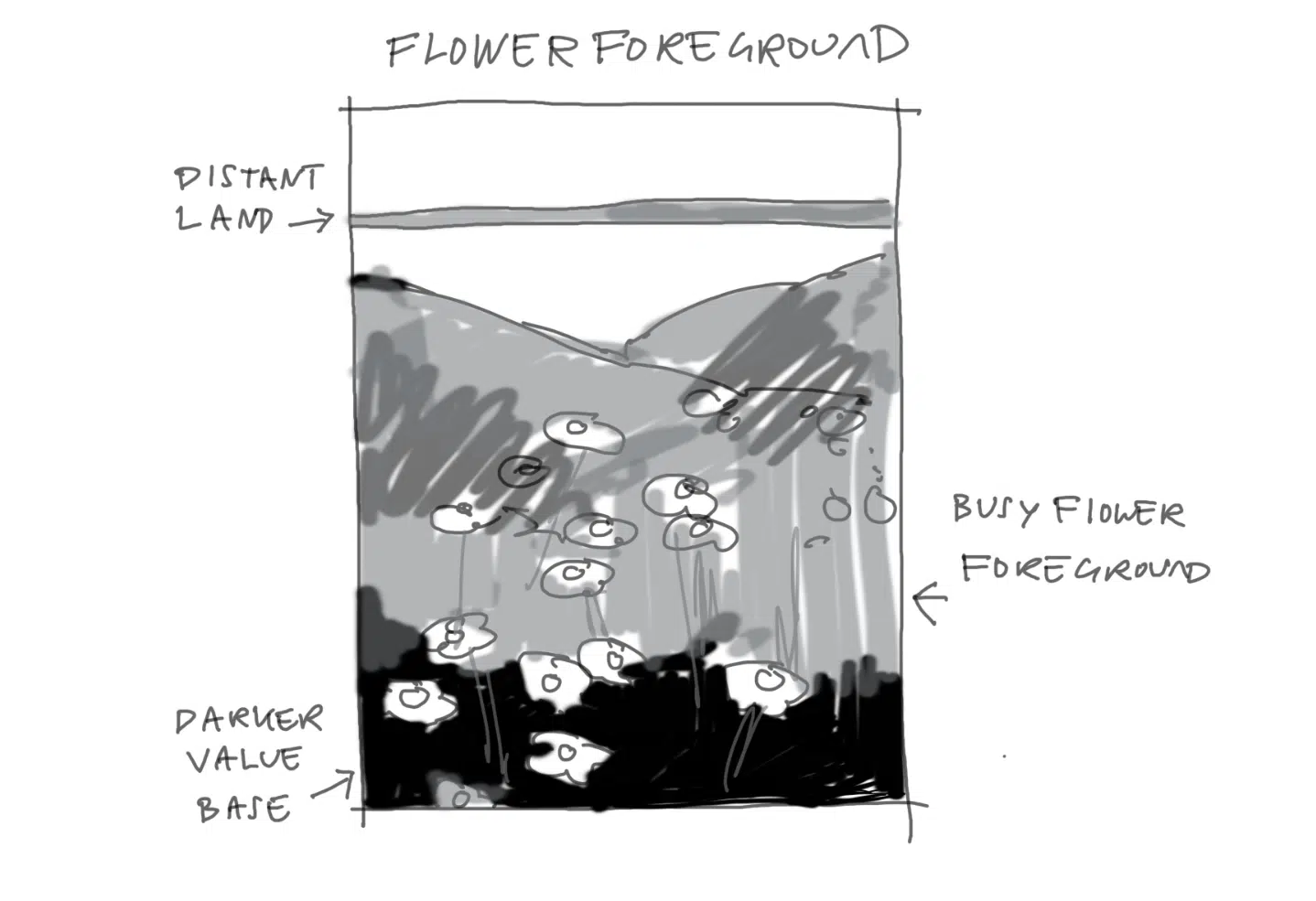
Just getting the composition down, mapping out the value structure, seeing where the darks and lights fall, and figuring out where the problems are going to crop up. It might be colour notes, or things I noticed.

You can do this with actual physical sketches, or on an iPad if you prefer digital. Doesn’t matter. What matters is you’re thinking about the painting before you’re in the painting.

And here’s the magic part: you sleep on it.

You give your brain a whole night to process what you learned. You step back from the subject. And when you wake up the next morning, something interesting happens: you’re actually more excited to paint it, not less. Because now, you’re not walking into the unknown.

You know what you’re doing.

You know what to look out for.

You’ve already solved half the problems while you were asleep.

The preparation is the work

It’s a bit like how film directors don’t just show up on set and wing it. They spend months in pre-production, storyboarding every shot (essentially a hand-drawn version of the final movie), working out every angle, so that when it’s time to actually film, they’re not figuring things out; they’re executing a plan.

Pixar spent over 2.5 years storyboarding Toystory before they animated a single frame.

That preparation is the work. The final painting, the final film, the final animation is the execution of all that thinking.

Why you need tea & biscuits

My brothers and sisters think I spend my days lounging around in some sort of artistic reverie, wafting a paintbrush toward a canvas in a state of internal bliss.

What we’re actually doing when we paint is solving hundreds of tiny problems, one after another, making decision after decision after decision. Which edge to soften? Where does that value shift? Is this colour too warm? Should that brushstroke follow the form or cut across it? It’s exhausting.

That’s why we need all the tea and biscuits afterwards, we’re recovering from genuine mental effort!

And this is exactly why my Midnight Sketch Club works so well. By sketching the night before, you’re solving a huge chunk of those problems in advance.

Now you can actually focus on the painting itself, rather than burning through your decision-making energy just trying to figure out where things go.

I was listening to a podcast, and Darren Cahill, co-coach of the current world No. 1 tennis player, Jannik Sinner, discussed Roger Federer’s work ethic.

“I did a week with Roger Federer and was stunned how hard he worked on the practice court. Four and five-hour blocks on the practice court. I never knew this about Roger because if you go and watch Roger warming up for a match, it looks like he’s going out to play with a country club, or he’s just slapping the ball around, barely out of his feet.”

He said:

“Darren, all the hard work is done in the lead-up. I just have to feel the ball and feel good about my game. Everything is done away from the public’s eyes. The actual match court is just for show. It’s when you are practising inside a stadium with zero people watching, that’s what really matters, and that’s where you’re putting in all that hard work. If you can accomplish that, then you can accomplish some great things.” – Roger Federer

So sketch at midnight

Map the values. Find the problems. Then sleep on it.

I think you’ll be surprised at how much better your paintings turn out when you’ve given yourself that gift of preparation.

Have a great evening,

Will

Continue ReadingThe Midnight Sketch Club

Why Copying Other Artists Leads to Your Own Unique Style

Left: The Jester Don John of Austria, Diego Velázquez. 1632–1633.
Right: Buffoon Don Juan of Austria, John Singer Sargent. 1879.

You’re six months into painting, with a couple of decent Monet studies under your belt, and you’re starting to experiment with Van Gogh’s impasto brush strokes.

A friend walks by your easel: “Oh, you’re copying again?”

That word, copying, lands like an accusation.

It doesn’t feel like “real painting,” does it? Real painters have an original vision. Real painters have their own unique style. Real painters don’t spend Tuesday afternoons recreating someone else’s portrait from 1885.

Except they do. They did. They all did.

Continue ReadingWhy Copying Other Artists Leads to Your Own Unique Style

How to (Actually) Achieve Your Art Goals in 2026

Last week, I sat down to write new goals for the year ahead.

Eating healthier, moving more (that came up a lot!), and I noticed myself saying something I’ve said many times before. “This year I’m going to paint more plein air.”

It sounds reasonable. But I’ve learnt that with painting and drawing, more isn’t the thing that moves you forward. Focus is.

Alignment over Inspiration

If you want to reach your art goals in 2026, you need better art alignment.

Last week, we talked about how any mark you make is progress. That still stands.

But when you have a specific goal, it helps to be specific with your practice too.

If portraits are your goal, you don’t need to “earn” your way there by painting still lives first. Even a small, focused study, like an ear, can move you closer to where you want to be.

I made the mistake of telling my sister about my resolutions, and she phoned yesterday to check up on me! I made a fumbled excuse about it being too cold to go outside to paint (I know some readers will laugh who are in -25 degrees, so appreciate my excuse is unfounded!)

So today I’ve propped an easel in the kitchen warmth, looking out the window. Heating on and tea by my side.

It’s a small move towards plein air.

Reading an article, watching a video, or reading a book counts as research, but it isn’t the same as actually practising drawing or painting.

Time under Tension

Instead of asking whether you’ll paint more portraits this year, try planning the kind of day that, repeated often enough, would make improvement inevitable.

It’s usually not a matter of finding the time, but of doing the thing you said you wanted to do in the time you set aside for it, without letting yourself drift into something else.

As the year unfolds, check for alignment. Treat new methods as learning, not success or failure. Create in ways that energise you. And be kinder to your artistic self.

Like drawing a portrait, a slight adjustment in direction can change everything.

Wishing you a calm, creative New Year ahead.

Will

Continue ReadingHow to (Actually) Achieve Your Art Goals in 2026

The In-Between Days: How Tries Become Marks, Marks Become Evidence

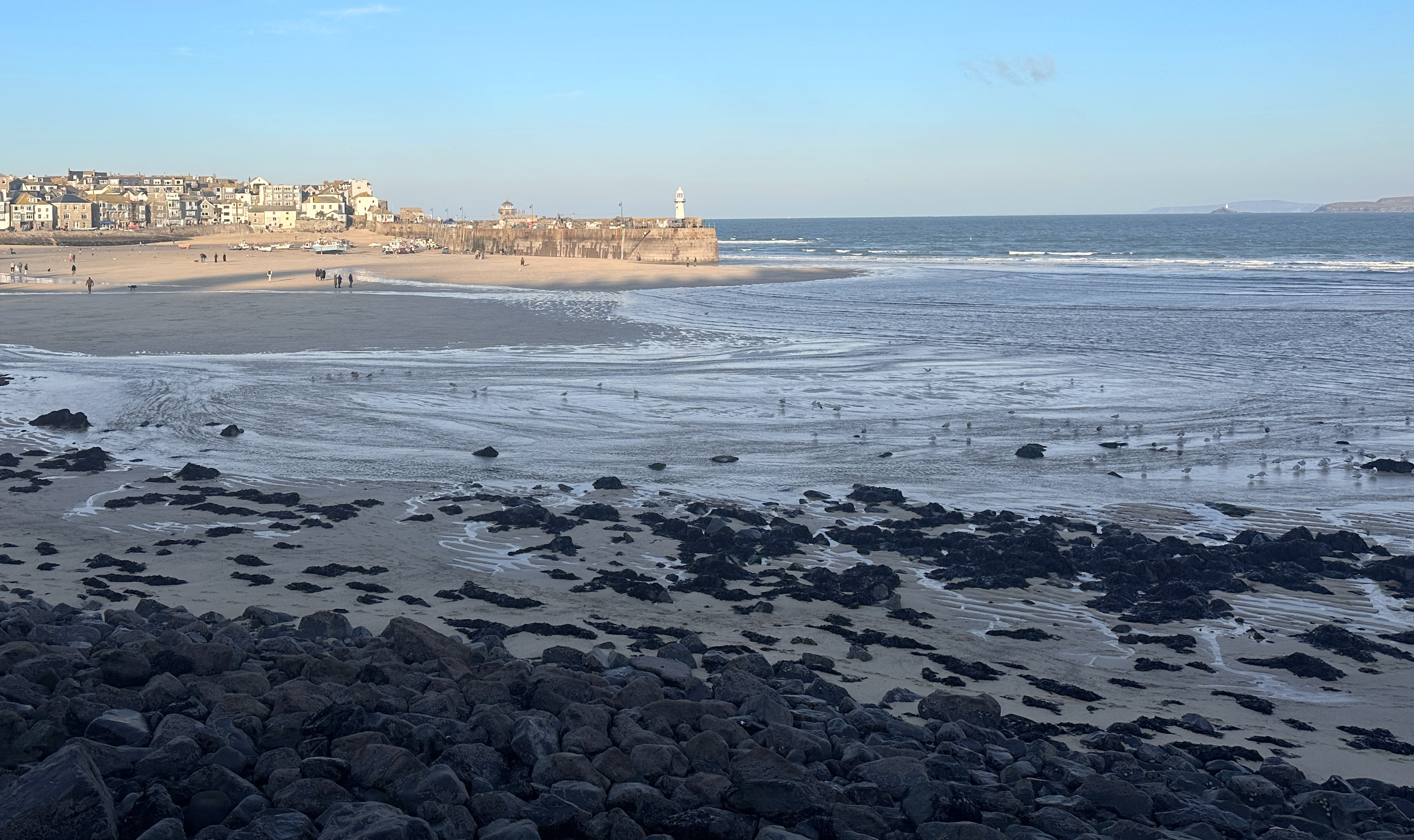
Winter Walk, December 2025

As the pace softens and the new year comes into view, there’s often a quiet sense of possibility in the air.

It’s like a mirror has been held up to what you’d promise yourself you’d do – if only you had the time.

This is when expectations and comparison creeps in.

Goals grow too big too fast, and before you know it, the idea of making this your “best art year ever” quietly freezes you in place.

So what do you do next?

Experiment without expectation.

Painting a wall is better than waiting for your next masterpiece. One colour on the page is better than agonising over the perfect nineteenth-century palette.

Doodle, draw, paint, make. If you are putting a mark to a page, you are creating.

Confidence does not arrive first. It follows the work.

Small, regular creative acts keep the wheels turning. Most breakthroughs happen while you are simply showing up, not forcing results.

A rough value study counts.

A colour swatch counts.

An unfinished sketch counts.

Four words that help

“I’ll try it anyway.”

I can’t draw an accurate portrait. “I’ll try it anyway.
I don’t have all the colours for the lesson. “I’ll try it anyway.
I feel uneasy sketching outside. “I’ll try it anyway.”

The tries become marks, and the marks become evidence.

Every sketch, every mix, every imperfect attempt quietly proves you are becoming the artist you want to be.

Picture yourself a year from now with a thousand small pieces of ‘artistic evidence’ behind you. Growth becomes unavoidable.

So step into that uneasy space before the new year. This is where artistic confidence is made.

Wishing you a fantastic, creative new year ahead,

Will


Continue ReadingThe In-Between Days: How Tries Become Marks, Marks Become Evidence

NEW! Beginners Oil Painting Course

Morning class, I’d like to introduce you to a new beginner’s oil painting course.

Welcome to my NEW Traditional Oil Painting Course for Beginners!

Over 5+ hours of tuition

This is a simple, easy-to-follow downloadable video course with over 5 hours of tuition, where you will discover the essentials of creating an oil painting. It has been designed as a step-by-step, rounded learning experience that brings together all my knowledge as a student, painter, and teacher.

What’s in the Beginners Oil Painting Course?

  •  5 x traditional oil painting demonstrations, taking you step-by-step from preparation and mixing and matching colours through to the final brush strokes. ✅
  • 16 downloadable video lessons, split into separate chapters that follow on sequentially.✅
  • Over 5 hours of detailed video instruction so that you can follow along at your own pace.✅
  • Downloadable reference JPEG images, line drawings, and a full materials list.✅
  • Lifetime access, downloadable on separate devices.✅

You receive more than five hours of video lessons, reference images, my drawings, colour swatches, and lifetime access with a one-time payment.

Learn at your own pace and complete your first oil paintings with a clear and structured approach.

You will complete five guided studies using downloadable reference images.

  • We begin with a wipe-out study that lets you carve out the form like a sculptor.
  • Then we move onto a limited palette jug study, a thin couche layer that allows the paint to blend and flow across the surface.
  • In the monochrome cup study, you learn the importance of value and brush choice using an alla prima approach.
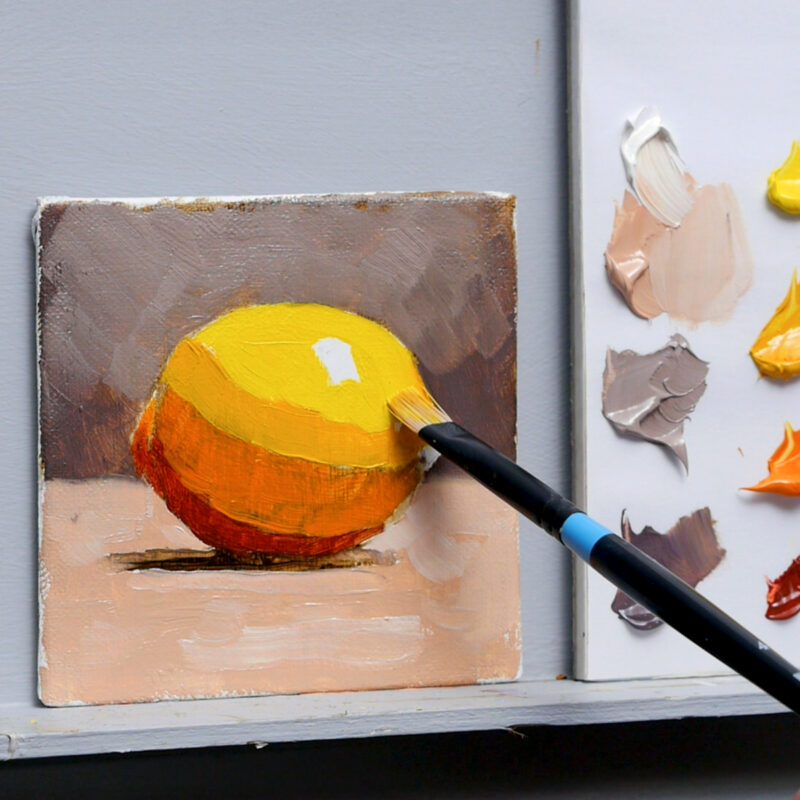
  • The lemon study introduces a four-stage, layered, indirect approach using the fat-over-lean method and teaches you to think ahead to make the most of your glazing.
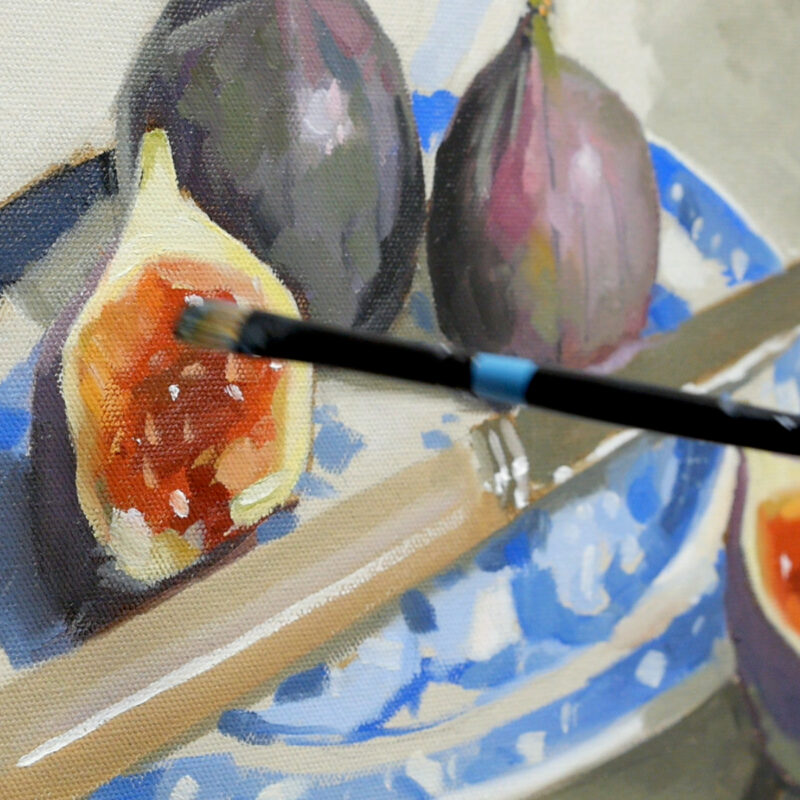
  • Our final study is a classical still life of figs on a plate. This tutorial enables us to build layers and expand our colour mixing, working with a split primary palette and balancing realism with impressionism through painterly brush strokes.

If you’ve ever wanted to start oil painting but don’t know where to begin, what materials you need, how to clean your brushes or how to avoid muddy colours, you are not alone!

Oils can feel confusing at first.

I help complete beginners learn to paint using classical techniques. I want to give you a clear plan so you can start oil painting with confidence.

Oil paints are a fantastic medium. They dry slowly, giving you more time to refine shapes, create smooth transitions, and build subtle shifts in light. With the right foundation, you can avoid the usual frustrations and enjoy the process.

When you’re first starting with traditional oils, there’s a lot to take in! To avoid overwhelm, in this course, I want to address some of the most common questions to help aspiring oil painters understand the theory and practice of painting in this medium.

Each of the five painting studies builds on the last and teaches a different approach, from direct painting to an indirect classical method.

By focusing on still life subjects, you’ll gain confidence with setups that you can easily find at home to continue your studies.

I trained in classical oil painting in Florence, Italy, and have over 15 years of online teaching experience and more than 300,000 YouTube followers. My focus is always on practical methods that give repeatable results.

Designed with the home studio oil painter in mind

On this Beginner’s oil painting course, we’re keeping it simple and practical, with an approach designed to work at home.

You only need a small brush kit (from Princeton Brush Company) a limited palette of pigments, minimal tools, and a safe home setup. The short video lessons show each stage step-by-step so you can follow along without feeling overwhelmed.

You will learn how to prepare a canvas, see values, avoid muddy colours, control edges, and create the right consistency for your paint. We cover the essentials of traditional oil painting: Underpainting, fat over lean, glazing, simple colour mixing, and when it comes to materials, I want you to understand the options available, from quick-drying oil paint to creating your own medium recipes.

If you work from a small room at home, the idea of Traditional Oil paints and the use of strong-smelling solvents and mediums is a real consideration.

But you do not have to use solvents! You can paint with oils straight from the tube, adding nothing to them.

Mediums and solvents, such as turpentine or odourless mineral spirits, are optional; they simply change how the paint behaves. So you could dilute with a natural oil, like walnut oil, or with a solvent-free gel. Think of them as ways to tweak consistency rather than requirements; it’s about balancing paint handling, drying times, sensitivity and where you are painting.

In the course, I demonstrate using a low-odour solvent and work in a well-ventilated space. Throughout the course, I’ve tried to cover less toxic alternatives. A guide to a safe working environment is included.

beginners oil painting course

What makes this beginner’s oil painting course different?

  • Calm and methodical, which builds skill in the right order.
  • Real-time decision making explained clearly as you paint with me
  • Simple printables and references, so practice is easy to repeat.
  • Both alla prima and indirect methods are taught.

So grab a brew, maybe a couple of biscuits, and join me on this Absolute Beginner’s Traditional Oil Painting Course to explore the magic of oils and surprise yourself with what you can create.

You might also enjoy these articles:
Oil Painting Terms for Beginners
Water-mixable Oils vs Traditional Oils

Continue ReadingNEW! Beginners Oil Painting Course

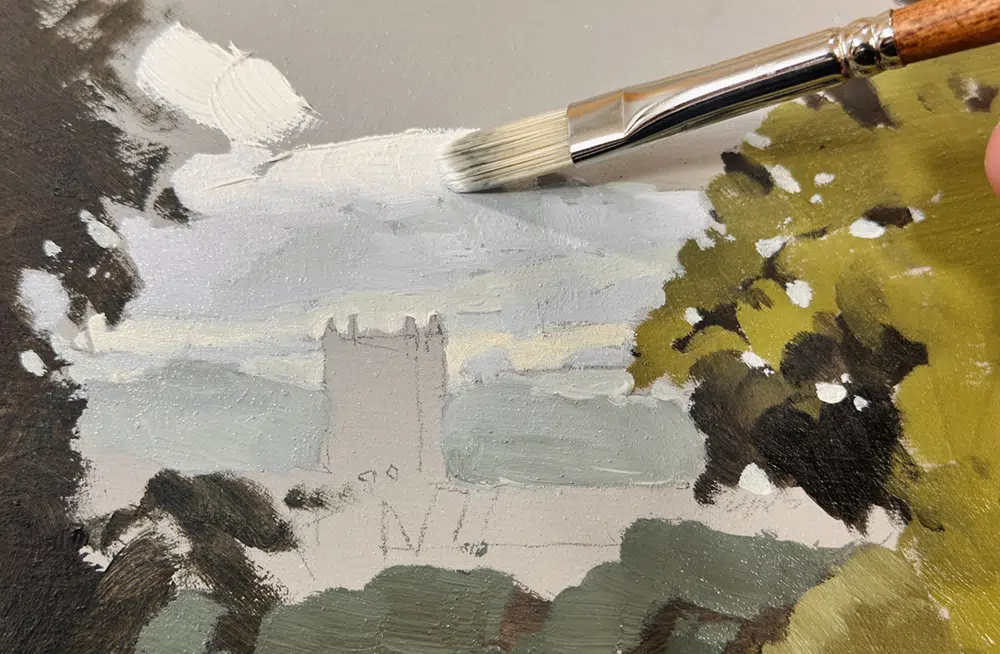
How to Create Depth in Landscape Painting: Understanding Value Compression

The secret to realistic depth in a landscape isn’t just simplifying forms and loosening brushwork; it’s knowing what to hold back on.

In fact, the real magic happens when you begin to reduce something most artists overlook.

Contrast.

Value Grouping: How Light and Dark Shapes Create Depth.

But isn’t contrast good?

Yes, contrast is important. But in landscapes, too much of it destroys the illusion of distance.

Creating depth means understanding how values shift as they recede. More specifically, how the light-and-dark relationships change from near to far.

Continue ReadingHow to Create Depth in Landscape Painting: Understanding Value Compression

5 Composition Categories That Can Fix Your Landscape Painting

“The pictures they created convinced me that anyone and everyone could use a few clear principles to build powerful visual statements: emotionally charged arrangements of shapes on a page.” – Molly Bang, Picture This: How Pictures Work

When you’re surrounded by hundreds of reference photos or standing in a beautiful location, it’s easy to feel overwhelmed.

Every scene seems to have potential for a painting, but nothing quite clicks. You find yourself thinking, “Would this work? Will that look good?” without ever feeling confident in your choices.

This is where ‘compositional categories’ can really help organise your imagery and give you a starting point to check your compositions against.

Not by limiting your creativity, but by giving you a clear lens through which to view your options.

Continue Reading5 Composition Categories That Can Fix Your Landscape Painting

Don’t Let Your Drawing Skills Fade Away: Understanding the Forgetting Curve for Artists

The brain is a forgetting machine

Imagine you’re in a drawing class.

Your pencil flows across the paper, and suddenly, it all makes sense. The proportions look right, the shading actually resembles the model, and you feel like you’re ‘getting it!’

You pack up your supplies with quiet confidence, already daydreaming about the drawings you’ll make at home next week.

Then life gets busy. A week later, you finally sit down to draw again, excited to pick up where you left off. You sharpen your pencil, study your subject, and… nothing.

The connection is gone. The techniques that seemed so natural have vanished. You’re not just rusty, you feel like you’re starting entirely from scratch.

It’s as if everything you learned has slipped away.

You’re not alone.

You’ve just run into one of the most common experiences in learning: the forgetting curve.

Continue ReadingDon’t Let Your Drawing Skills Fade Away: Understanding the Forgetting Curve for Artists

How To Paint a Still Life With Acrylics: The Yellow Family

Simple Acrylic Still Life Lemons

Morning Class,

For this step-by-step tutorial, we’re focusing entirely on staying within the yellow family of colours.

We’ll move from a bright, saturated Cadmium Yellow Light through to a darker, earthy Raw Umber, and see how much of a painting we can create just within that colour family.

The perceived limitation of the palette actually becomes a strength. It forces you to examine form, composition, light, and the interaction between objects.

But the main thing it helps with is colour mixing.

Once you have the colour scale, you can adjust the colours by moving up or down it without veering too far off course.

Continue ReadingHow To Paint a Still Life With Acrylics: The Yellow Family