

“The pictures they created convinced me that anyone and everyone could use a few clear principles to build powerful visual statements: emotionally charged arrangements of shapes on a page.” – Molly Bang, Picture This: How Pictures Work
When you’re surrounded by hundreds of reference photos or standing in a beautiful location, it’s easy to feel overwhelmed.
Every scene seems to have potential for a painting, but nothing quite clicks. You find yourself thinking, “Would this work? Will that look good?” without ever feeling confident in your choices.
This is where ‘compositional categories’ can really help organise your imagery and give you a starting point to check your compositions against.
Not by limiting your creativity, but by giving you a clear lens through which to view your options.
The Core Principle
This idea is drawn from Chapter 4, “Design a Pattern of Differing Values,” from Carlson’s Guide to Landscape Painting.
Carlson emphasises coming to your painting with an idea first.
What are you trying to encapsulate in your work? What are you drawn to?
You make an intentional decision about which element interests you most, then you design your composition around that single focus.
Don’t try to capture everything at once. It could be the dramatic sky, interesting foreground, distant mountains, or a collection of buildings.
Compositional Categories to Consider
“Nature is seldom perfect in design. The artist must look to nature for his inspiration, but must rearrange the elemental truths into an orderly sequence or progression of interests” : Carlson’s Guide to Landscape Painting
Here are some categories that can help you organise your thinking.
1. Big Sky Effect Landscapes

A low horizon line with an expansive sky dominating the composition. Perhaps a small silhouette of a building or landscape feature that anchors the bottom of the frame, but the sky is undeniably the star.
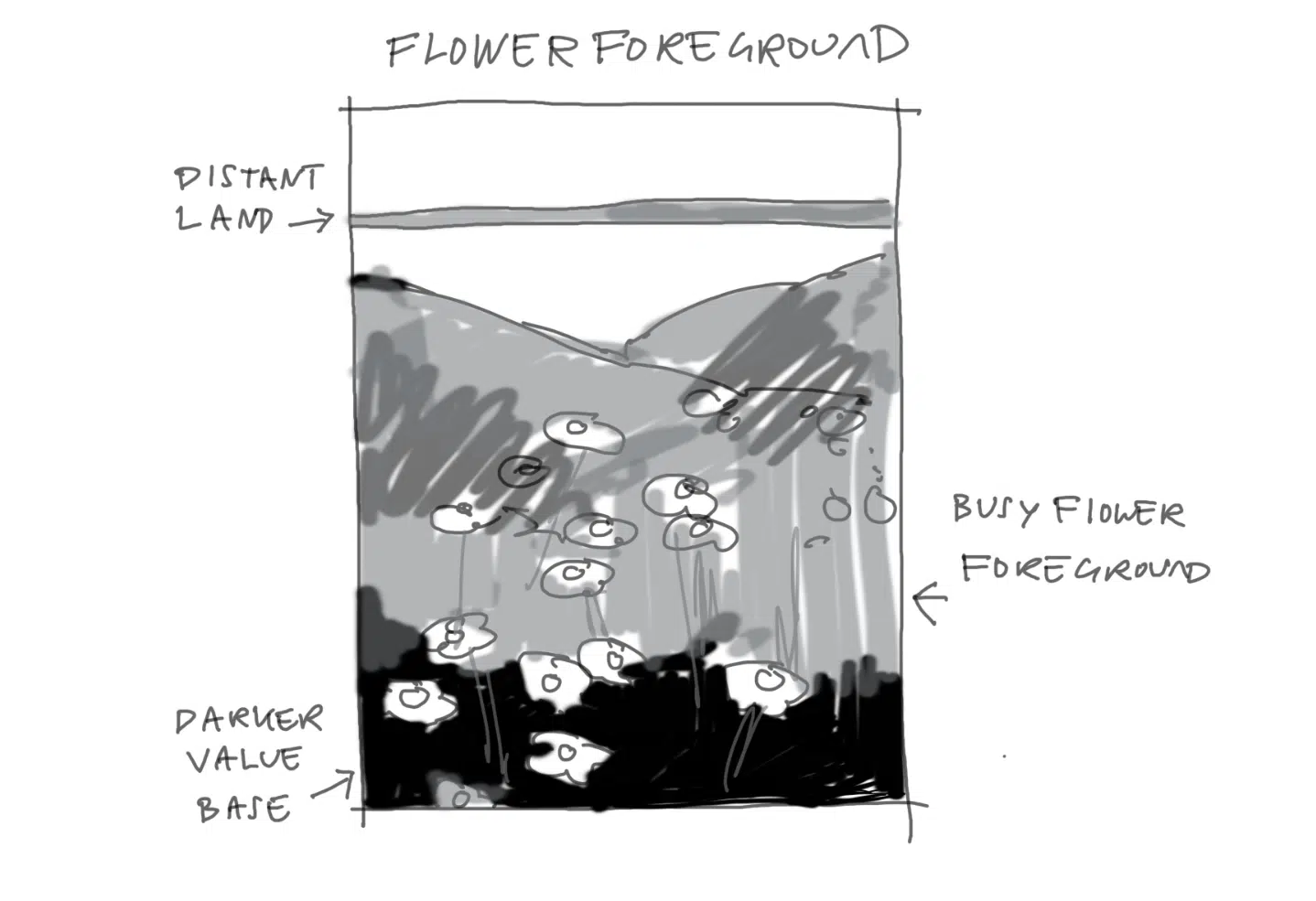
2. Foreground Florals

A low viewing angle that places grasses, wildflowers, or flowers in prominent foreground focus. Distant mountains or landscape elements providing context but not competing for attention. The far landscape is often high in the scene.
3. Single Tree Silhouettes

One tree becomes your focal point, isolated and given room to command the composition. Often a distant dark silhouette adds a sense of depth.
4. The Singular Object

A single boat, rock, or structure, often in a strong colour, like a bright red fishing boat, becomes the entire point of the painting. Everything else is cropped away or simplified to support this one element.
5. Collection of Buildings

Architectural elements grouped together, with the relationships between structures forming the compositional interest. These offer a more domestic view of the landscape and the human relationship with the environment.
How to Use This Approach Practically
The real power of this method is two-fold.
Looking through your existing photos but also giving you a compositional framework to bear in mind when in a new location.
Here’s how it works on your photo collection:
- Go through your images and categorise them first. Don’t ask, “Would this make a good painting?” Instead, sort them: “This could be a big sky. This could be a single object. This one has great foreground florals.” You can create folders in your photo library or on your desktop.
- Once categorised, review each group separately. Now you can evaluate which images work best within their category, rather than comparing hundreds of disparate photos against each other. You can then look more closely at cropping, or value patterns, and colour effects.
- Decide what you want your painting to be about. Suppose you want to create three paintings from the same location. You might decide to create one with foreground florals and distant mountains, another with a dramatic sky, and a third that isolates a single tree or rock formation.
Why This Matters
This approach helps you capture elements of a landscape across multiple paintings, rather than trying to force everything into a single composition.
Each painting tells a different story about the same location.
For example, if you have a photo of a red boat with an amazing sky behind it, you need to decide: is this a “singular object” painting about the boat, or a “big sky” painting? If it’s about the boat, the sky may need to be simplified or cropped. If it’s about the sky, you might need to minimise or remove the boat entirely.
Taking a Second Look
Once you’ve identified which compositional category your view or image falls into, take a second look, this time with a more critical eye.
Does your composition contain the additional elements that elevate it to truly compelling?
Amongst your selected images, or if you’re out on location, your chosen subject, look for something that has a variety of shapes, a range of tonal values, or a clear focal point. Consider whether the perspective creates visual interest, perhaps through an unexpected angle or a sense of depth that pulls the viewer into the scene.
Designing a Pattern
The key concept from this chapter is to look at composition as an arrangement of values and tone masses that support your idea and vision for the landscape. Below are a few of Carlson’s sketches, which use the same location but shift the focus or view each time, incorporating different elements.
“Every good picture is fundamentally an arrangement of three to four large masses – a design of differing masses or large blocks of color, light, dark and half-dark and half-light. ” – Carlson’s Guide to Landscape Painting

Example 1 – Using Compositional Category ‘Collection of Buildings’
Here’s an example Carlson uses of what not to do when arranging a composition.
- Each part has been given equal importance.
- The houses are straight on, and the scale of the trees next to the house are similar.
- There isn’t much depth.
- The lines are mostly horizontal, and there is no significant difference between shapes and angles.

Example 2 – Using Compositional Category ‘ Collection of Buildings”
Here’s an alternative view with a more successful outcome.
- There is a more noticeable difference between the scale of the house and the trees, giving more of a sense of the environment.
- A variety of shapes from the shrubs in the foreground, the larger tree trunk on the right, and the far mountain in the distance.
- A more dynamic relationship in scale between the house and the trees.
- The building serves as a focal point, adding depth to the scene.

Example 3 – Compositional Category: Big Sky/Mountain Effect Landscapes
- The sky/mountains become the main focus.
- The house and trees are arranged along the lower third, allowing the mountain and sky to take on greater importance in the view.
- It feels like we can see far into the distance, and the houses have a more interesting perspective.
“If your interest is in a “sky effect, ” the predominance of space will naturally be allotted to it. Or in a sky-and-mountain mood, the space arrangement of Diagram No 13 might answer” – Carlson

Example 4 – Landscape Painting Compositional Category: Floral Foreground.
- You still have a subtle indication of the building in the background, but far into the distance.
- The very dark value at the top of the drawing draws your eye due to the contrast, with the white house set against dark trees.
- The flowers or fauna in the foreground become the focus.
- A type of flower or colour can be so location-specific.

Example 5 – Compositional Category: A collection of buildings
- By getting close to the scene, it has a domestic feel.
- The signs of life and the balance between human-made and natural elements become more prevalent.
- The winding path’s perspective leads your eye.
- There is a dramatic jump in scale between the tree close to us on the front left and the bush next to the house.
Experiment
If you’re working from a reference image, converting it into black and white can help you to see the values (light and dark areas) more easily.
You’re looking for large, simple masses and simple shapes that describe the essence of the scene. It’s not always the big vista you remember from experiencing a new place. It might be a side alley, a change in light, a rock formation.
By having a single, strong visual element or perspective, you can create paintings that have a more compelling or visually engaging narrative.
(For approaching the arrangement of value masses, you might enjoy this article on Notan Design)
Pro tip: We’ve explored Carlson’s philosophy before, when learning about planes, angles and lighting effects in landscape painting.
You can see the articles here:
Beginner Landscape Painting Concepts – The Theory of Angles
Acrylic Landscape Painting Techniques – Carlson’s Theory of Angles (Demo)
Cheers,
Will
P.S. If you’d like to learn more about landscape painting composition sketching: Landscape Sketching Course
If you’d like to go straight into an Impressionistic landscape painting course: How to Paint a Monet Landscape Course


Many books and articles make composition very complicated. Thank you for this simple but clear guidance.
My pleasure, really hope it helps with your landscapes
Many thanks for this Will, it’s very helpful. I’ve taken an interest in castles lately and struggling with so much stonework up close. I’m off to re jig the elements!
Ahh good one Suzannah, hope it gives them a new focus.
Thanks a lot Will!
Cheers Tamara
This is brilliant!! Love how the examples give options to stretch an idea by changing the focal point to build up a series of paintings for more engaging story-telling! Super helpful, Will!!
That’s such a good description Chacha ‘stretch and idea for engaging storytelling’
Hello Will,
Thanks for writing about this. Even though I’ve been brave enough to try things on my own, I know it was aimless … and came out that way. With the seasons moving us more indoors, this mindful articulation is timely and inspiring. Thanks.
Great you’re feeling inspired Laura. The same concept can also work with other subjects, not just landscapes, so it can be an adaptable approach.
A timely post Will! I am working on a small landscape that features steep granite cliffs in Newfoundland – now I will go back and simplify the foreground and figure a way to give my composition more depth. Thanks so much for your excellent explanation.
So pleased it was good timing for you Donna, fantastic.
The examples are extremely helpful. Thank you for sharing with a newbie!
My pleasure Helen, hope they help.
Hi Will. My copy of Carlson’s Guide to Landscape Painting is tattered from so much use! It’s the BEST resource, especially here in the Canadian Rockies, where you could spin in circles for days before choosing the “best” view! Mountains and autumn colours…yes, please!!! Thanks for the fantastic articles Will!
Oh wow, yes the Rockies, what an place for painting.
Another Great Post, so well explained with your sketches. Many Thanks Will
Cheers Tom
After reading your recent absorbing post, I realize that I already use a certain amount of Compositional Category when choosing my next landscape painting . Many times this is dictated by chosen locations of interest such as mountains, buildings or seascapes and also times of year – the four seasons .Currently I am preparing potential subjects of interest for ‘Autumn’ at my local u3a ‘PaInting Group’ which i hope will include Autumn colour palettes set in a landscape with interest such as buildings, bridges and water reflections such as the Fall in New England and Japanese Gardens including a pagodo
Great stuff Keith, hope the show goes well.
In other words, if you want a boring picture place your horizon in the middle.
Not necessarily boring, but if you wanted to focus on the calming nature of the sea, or a view, having a central horizon can work to your advantage.
You are a lovely man Will, thank you for sharing. That was a great read and makes so much sense.
Thanks for your kind words Alain, so pleased you enjoyed it.
Will
Funny thing. I was struggling with the question of ‘big sky’ or ‘big yellow yarrow field’ in a landscape I wanted to tackle. Your notes on this helped this along. Tx, Will.
So pleased it helped Rob, often pushing the composition to the extreme to one way or another can help to find that Goldilocks ‘just right’ feel.
Thank you very much for this helpful article. For the first time I can finally look at landscape photos without feeling overwhelmed. Thank you again for all the tips, information and diagrams.
Glad you enjoyed it Nour.
Will