


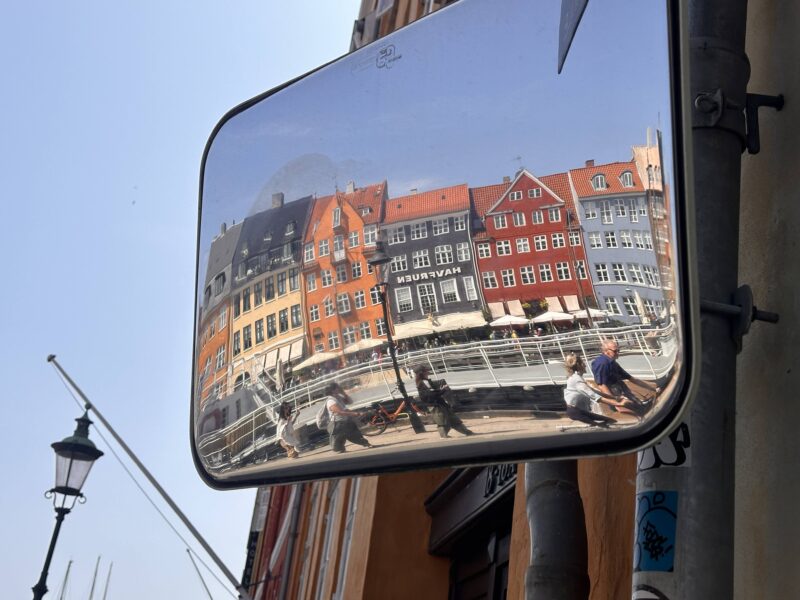
It’s impossible not to pause in Nyhavn.
The colours bounce off the water like a painting. I kept thinking how many artists must have stood here, brush in hand, trying to catch that perfect line where ochre meets cobalt.
It was a fresh, clear morning, and I was exploring one of Copenhagen’s most picturesque 17th-century districts.

Brightly coloured townhouses and traditional wooden boats line the canal, originally a commercial port, Nyhavn is one of the oldest parts of the harbour.
Now a bustling promenade, warehouses have been renovated, featuring outdoor restaurants and bars, making it the perfect setting for capturing a few sketches.
Finding Your Subject: The Art of Reading a Scene
One of the most valuable skills for urban sketching is learning to read a location before you even pick up your pen.
When I arrived at this canal scene, I took a moment to observe where people naturally gathered. Crowds will often indicate the most compelling viewpoints, spots that truly capture the essence of a place.
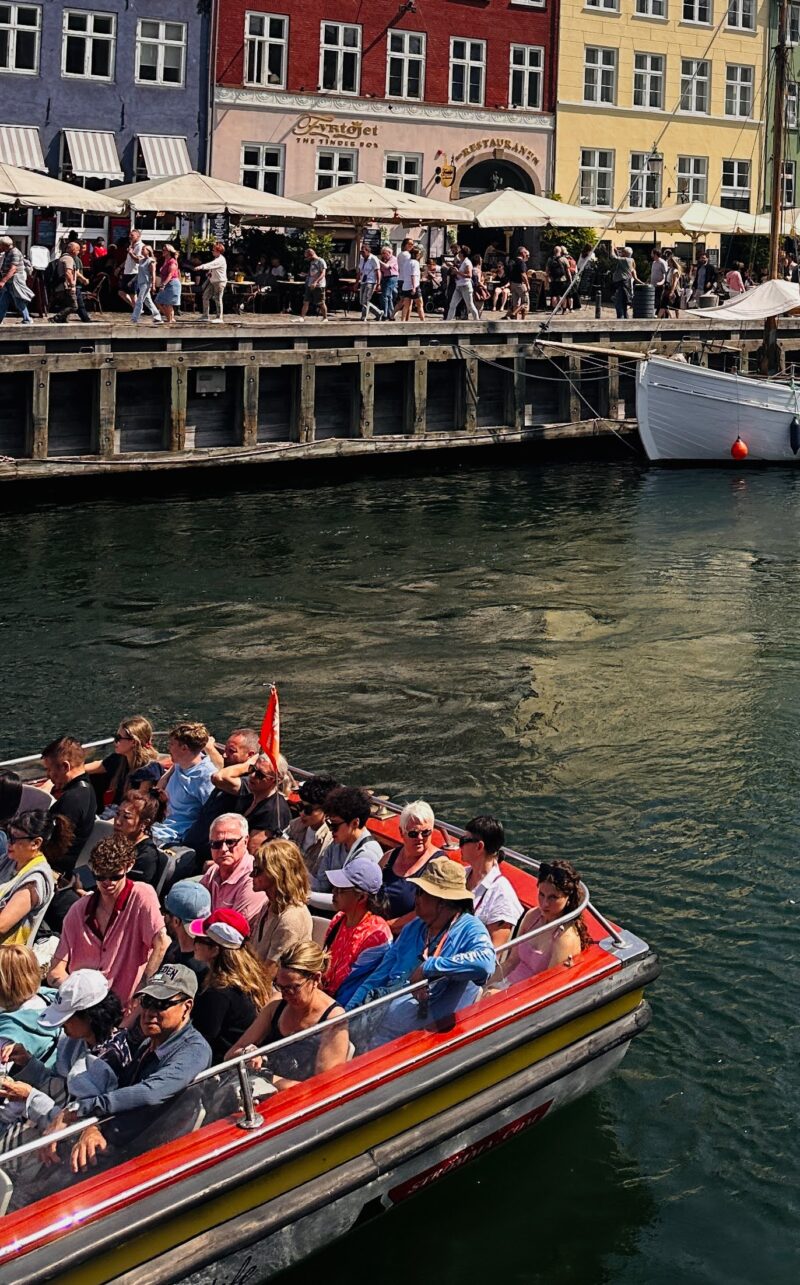
This led me to an elevated position on a bridge, where locals and tourists were drawn to watch the boats below.

From the bridge, I had a wide view of the canal, but rather than trying to capture everything, I focused on a single boat positioned on the right side of my composition. This selective approach created several advantages:
- Depth and perspective: The boat served as a focal point while the buildings on the left provided context without overwhelming detail.
- Scale and life: A lone figure with his bicycle became my reference point for scale, bringing human presence into the scene.
- Visual rhythm: The white umbrellas along the canal created a pleasing pattern that broke up the composition’s base.

The Drawing Process: Building in Layers
Step 1: Foundation with Pencil
I started with a pencil to establish the crucial elements, the boat’s proportions and the height of the mast. These were the first elements to get down.
Step 2: Defining with Pen
Using a 0.5mm MUJI pen, I worked over the pencil lines and focused on the essentials rather than everything I could see. Suggesting rather than rendering (like indicating a row of bikes with just a few wheels), the white line of the umbrellas helps to separate the crowds of people from the buildings above.
Step 3: Adding Tone and Atmosphere
With a mid-tone grey marker (found locally at a Copenhagen MUJI shop), I blocked in areas to separate different planes in the composition. This helped establish the light and shadow relationships and create a focal point around the boat.
Step 4: Anchoring the Darks
Finally, using a black Pentel brush pen, I added the deepest shadows, including the open windows, the shadow under the boat, and areas in full shade.
Trust your instincts about location. If people are drawn to a view, there’s usually a good reason. Use crowds as your guide to finding compelling subjects, but you don’t have to capture the whole scene.
Leave room for colour. This pen and ink approach creates a perfect foundation for watercolour washes if you want to add colour later. The goal isn’t photographic accuracy; it’s capturing the feeling and character of a place.

Sketching the bike

This bicycle, casually propped at an angle, offered a perfect study in light and shadow. The seat created a bold, dark mass while the front wheel seemed to melt into the flowers on the left.
There was a row of reflective windows running along the building’s facade. These weren’t just architectural elements to record, but they functioned as tiny portals, reflecting fragments of the surrounding cityscape.
These quick sketches are a snapshot of the scene, my aim that morning was to capture the sheer enjoyment of experiencing a new place. I’m subconsciously absorbing the atmosphere and smells, and sounds as I work.
Bistro set

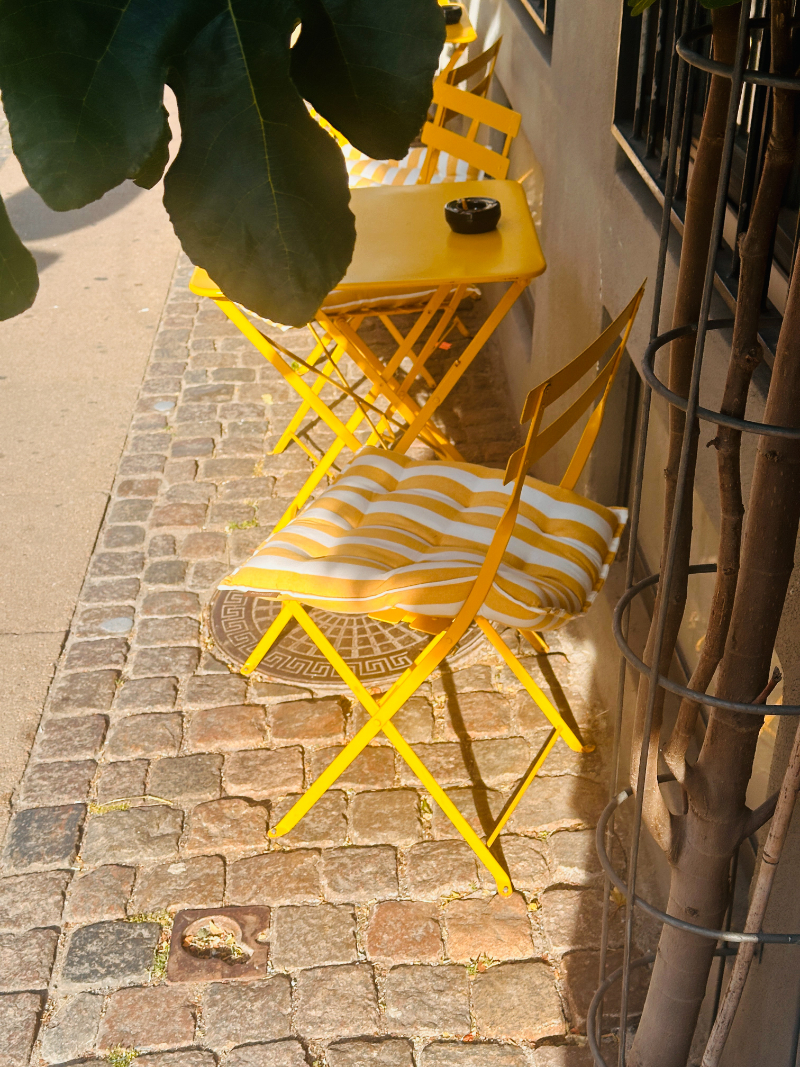
Every sketch is its own discovery, and some of the best subjects are hiding right under your nose.
This bistro set was just outside our hotel, something I’d walked past countless times without really seeing. But one morning, the bright yellow seats and striped seating caught my eye when the sun hit them.
The tangle of chair and table legs created this intricate web of crossing lines, like a geometric puzzle. I feel that the image would probably work better in colour, but exploring in black and white can be a great test to see how the structure of the image holds up.
Sometimes the most compelling subjects are the ones you see every day, but it’s when you finally take time to really look.
Hart bakery
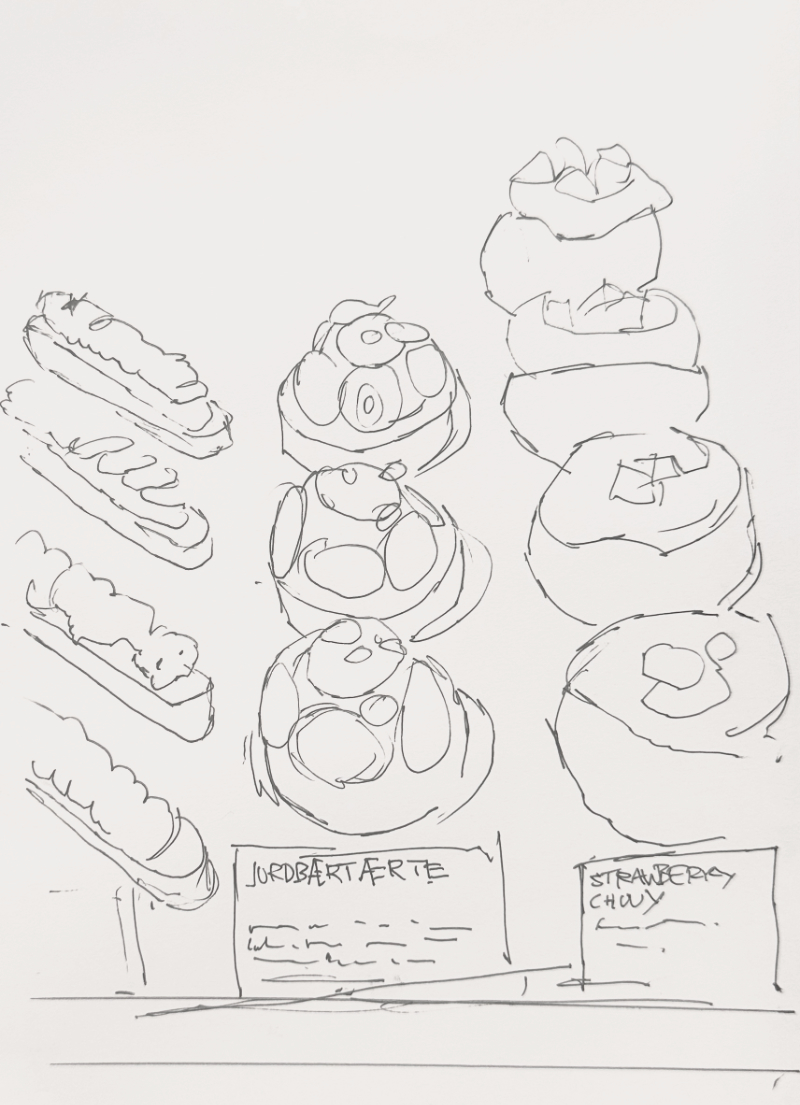
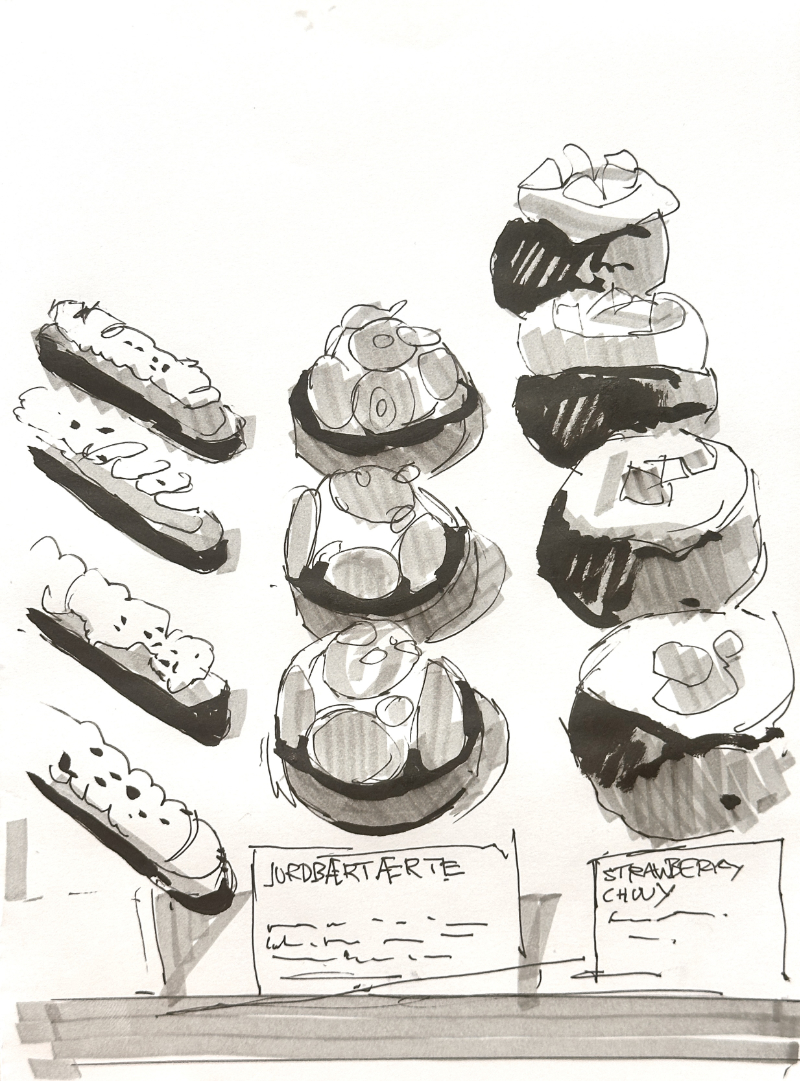
This sketch came from Hart Bakery, where I loved the beautiful uniformity of the cakes all lined up. Each individual pastry had its own distinct pattern and character.
The composition would work well in watercolour with those vibrant reds from the strawberries punctuated by tiny flecks of green.
My process for the sketch remained consistent, starting with the MUJI pen (Gel Ink Ballpoint Pen) to establish the basic forms, then moving to the angled fibre-tip pen for mid-tones to block in the major shapes, and finally using the Pentel brush pen to anchor the deepest darks throughout the drawing.
Sometimes when you’re sketching on location, adding a bit of text to the composition can be a lovely touch. It transforms the sketch into more of a personal diary entry, capturing not just what you saw but where you were, the language, and the fonts.
Sheltering from the storm
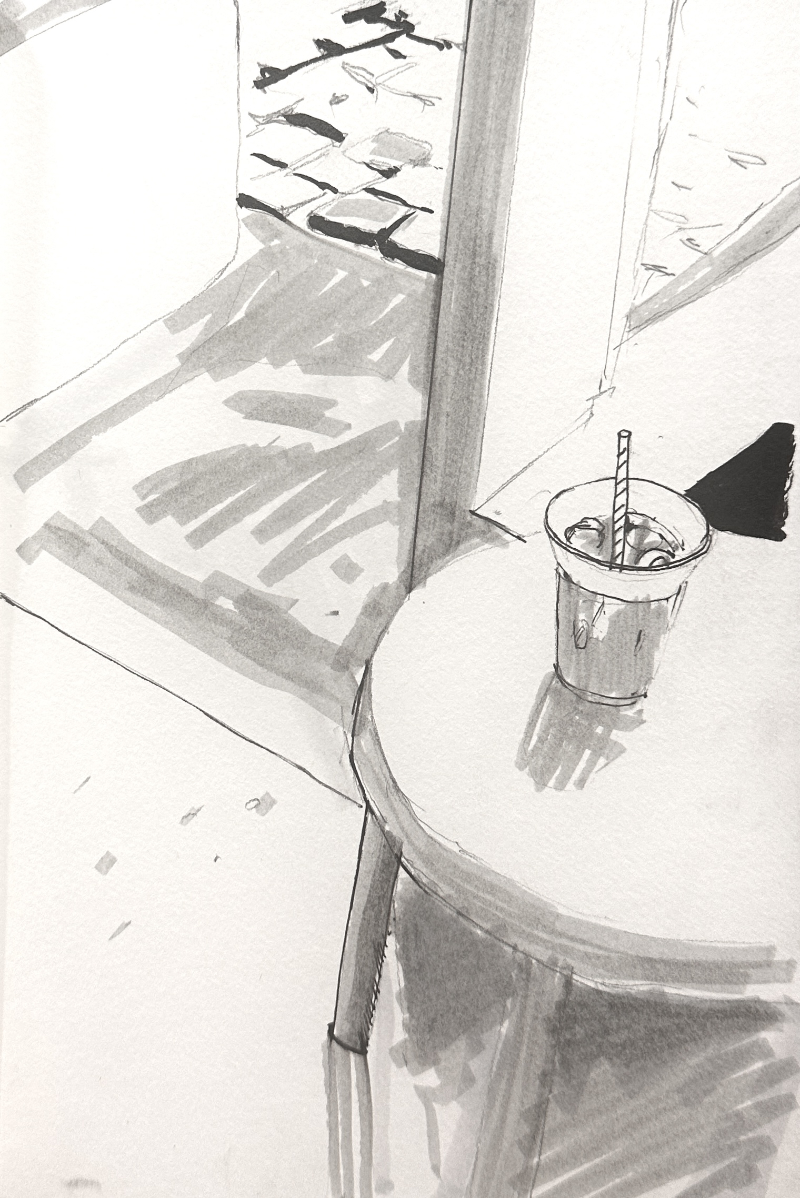
Sometimes the best holiday memories come from unexpected moments, like when torrential rain forces you to duck into a bakery for shelter!
While waiting out the downpour, an iced drink was placed on the table next to us, with its striped straw that perfectly echoed the brilliant blue accent on the left side of the composition.
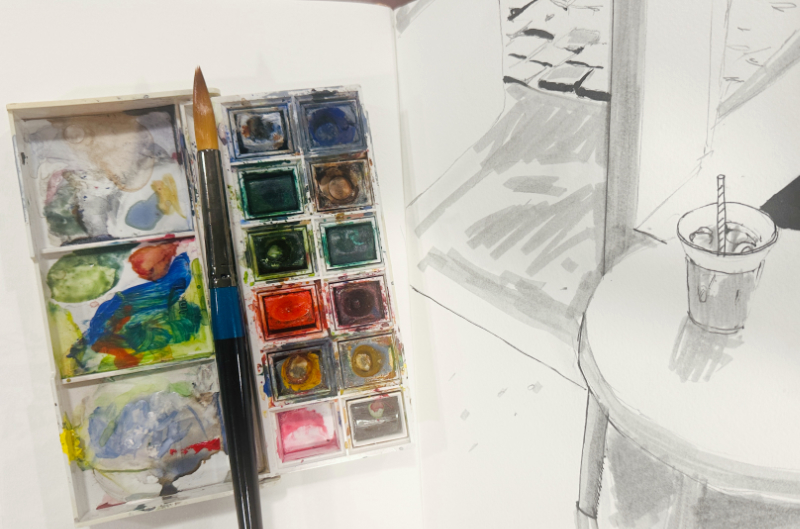
The colour balance called for watercolour.
I used a small Cotman watercolour travel kit and started with a pencil to carefully establish those angular, dramatic shapes and get the proportions right. I used a ruler to get the lines of the door frame, as I wanted to keep the strong geometry.
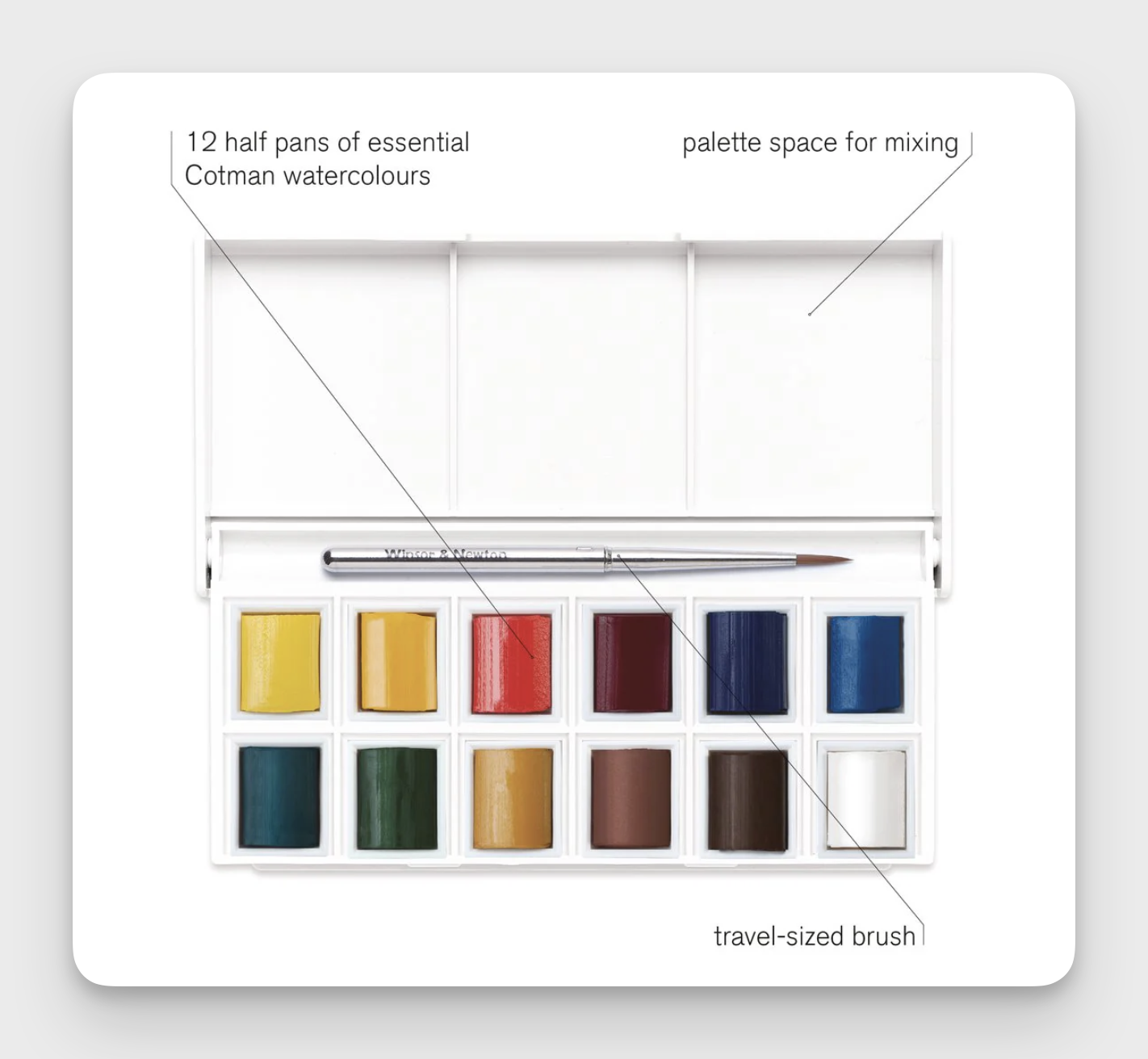
Winsor & Newton, Cotman Sketchers’ Pocket Set
Once the pencil sketch was in, I added pen work and then used the grey marker, though in retrospect I probably could have achieved those mid tones with watercolour alone and saved a step.
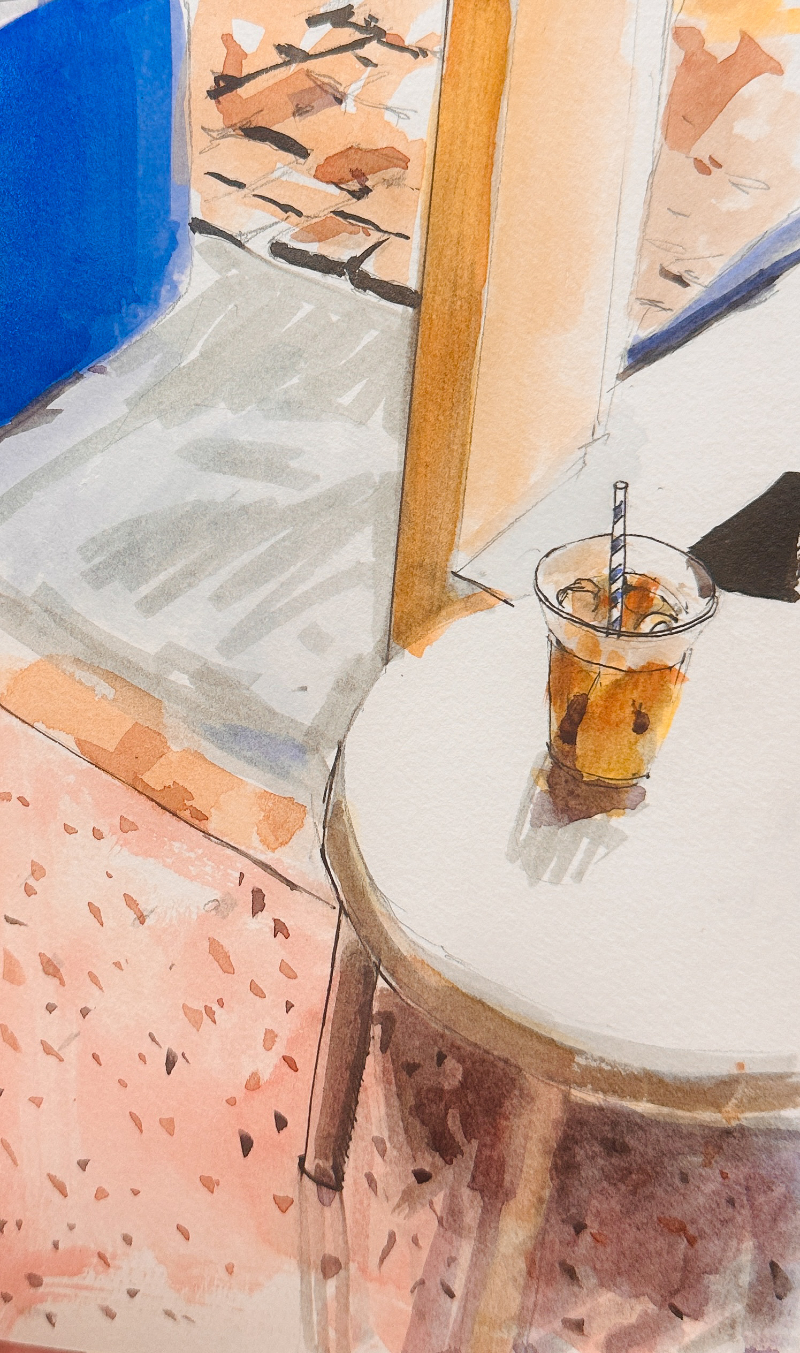
I loved adding the pattern work on the floor in the foreground. Those colourful marks became my favourite part of the whole piece, creating visual interest while capturing the character of this little refuge from the storm.
Hans Christian Andersen in Nyhavn
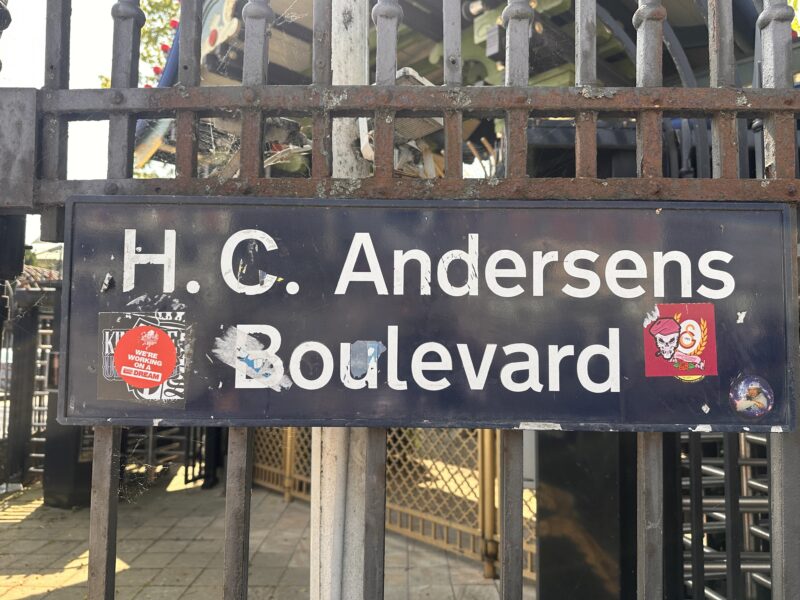
Walking around the streets almost feels like you’re walking in the Danish writer Hans Christian Andersen’s footsteps. He spent the majority of his life living in three different houses in Nyhavn.

- No. 20, the home of Hans Christian Andersen, is the red building on the left-hand side of the photograph
From September 1834, Andersen was a lodger at No. 20 on the second floor, renting two rooms. His sleeping room faced the courtyard and the Botanical Garden, while his combined living room and study faced the canal.
He did this lovely sketch below from his window.

Drawing by Hans Christian Andersen of “Nyhavn from my window”, 1834
I love the simplicity of the line and the way he’s used the scale of the masts to indicate depth. The single white band on the focal point of the boat centres us on the junction of the water.
It was here he wrote his first fairy tales, which were published in May 1835. The small publication contained “The Tinderbox”, “Little Claus and Big Claus”, “The Princess and the Pea” and “Little Ida’s Flowers”.
Although known for his fairy tales, Andersen also wrote 36 plays, six travel books, six novels, hundreds of poems, and approximately 170 short stories in his lifetime.
Alongside sketching, meandering and pastry eating that morning, I spotted a Gauguin and Degas show on at Glyptoteket, an art museum across the city, so that’s where I headed next.
I’ll share the exhibition review next time.


This is wonderful Will !
So glad you could get this beautiful holiday this year ! Thank you for sharing !
Best Louise
I love these sketches. You’ve inspired me to try adding grey and black brush pen marks to my sketches. I’ve been using a Sailor fude pen recently, which produces lovely varied lines, but some shading in grey and black would I think complement them nicely
Good on Euan, yes love the marks you can get with the Sailor, the brush pens can be so nice for adding texture.
Will
I really enjoy your newsletters. Your sketches are lovely and very inspiring. My sketches always end up looking to heavy. I need to use smaller pens.
Hey Vicki, yes for the MUJi pens you can also get them in 0.38 which is really nice and fine, and any fineliner under 0.5mm will work. Try using a fineliner like a pencil to sketch in loosely and then go with a thicker pen to reinforce your first marks.
Will
Love love love ! Thank you for sharing your amazing trip!
My pleasure Melanie, so pleased you enjoyed it.
Will
Absolutely love catching your latest travel adventures and sketches—always a treat! Your advice is spot-on, as always, though I have to admit I always get a little hungry right after reading (must be all the inspiration!). The tidbit about Hans Christian Andersen was fascinating—never knew that about him. Looking forward to your exhibition reviews!
Cheers,
Jim
Glad you enjoyed it Jim!
Your amazing and generous with your teachings. Greatly appreciated….read on my train back to oceanside. Ca
Ahh, you’re very kind Char.
Love Copenhagen! Thanks, Will, really enjoyed your article. A great reminder how useful those Muji pens are. Looking forward to your review of the Glypt exhibition.
Cheers Stephanie, yes, so enjoyed the city.
Thanks so much for this email. I’ve just come off a course (in person) of watercolour. And at a pivot point. I’ve always used either oils or acrylic in these lady 10 years (fumes) but watercolour is so very different. It’s very enjoyable but thought I’d get back to ‘real art’. But your newsletter shows me there is no real art, only art, and using a different medium or all mediums is still art.
Thanks again, Kathy
Hey Kathy, so pleased you enjoyed it. Every medium brings something special to the table, and bouncing between them can actually make your overall skills even stronger, so yes working between mediums can be a great approach.
Will
Really enjoyed that, Will, thank you. A brilliant artist and an excellent travelogue writer. What’s next? Are you going to accompany these posts with musical compositions of your own?
Ha, ha, who knows what will happen next time David! glad you enjoyed the sketches.
What a bright spot in my lazy Sunday, receiving this email!
I’m adoring your sketches and am glad to be reminded to start at them again.
I had no idea HC Anderson was so prolific outside of his fairy tales.
Always great to receive any emailing from Will Kemp!
Thanks Linda, so pleased you enjoyed them.
Hello Will .
Great to read about your time in Copenhagen and see the sketches you made whilst there .
Thank you for sharing them .
Patrick Halloran .,
My pleasure Patrick, glad you enjoyed them
Thanks Will
Just echoing the lovely comments already made about your travel and artistic generosity.
Thanks again mate as we say in Australia!
Cheers Ron, much appreciated.
WOW, what a great newsletter…Really enjoyed reading the inspiring tips and insights. I put the brushes down quite some time ago, but picked them up again only this week when I attended a “Paint n Sip” evening here in the lovely great south of Western Australia. A little French patisserie hosted the evening and we painted images of strawberry tarts while enjoying a cheese board and wine. Reading about your holiday and seeing your wonderful sketches has given me an injection of motivation. Thank you. Jan
Sounds a perfect way back to painting Jan! so pleased you’re feeling inspired.
Will
Thanks so much for this Will. My husband has been suggesting Copenhagen as a destination for a trip this September and now I’m convinced! Your emails are always so generous and packed with little tidbits of info and very much appreciated.
Glad you enjoyed your time.
Great stuff Margie, hope you have a fantastic time.
Thanks Will, your sketches brought back memories of walking in Copenhagen! You are inspiring me to begin your Beginner Sketching Course which I recently purchased. Now have all the required implements!!! So will set too in the next few days!! from Julia
So pleased it brought back nice memories Julia. Hope you can find some photos from your trip for inspiration for sketches.
Will
Thank you for sharing your inspireing Copenhagen Urban Sketches with us all.
A few years ago I went on business to Northern Denmark based in Alborg. During a welcome weekend break from work, I went to the most northern picturesque fishing port called Skagen. If any of you are any where near in future I highly recommend a visit with your sketch book. Unfortunately I didn’t pack my sketch book. I took a short dip into the sea where the Skaggerak and Kattergat meet on a pennisula. Needless to say I only dipped my feet for a very short time – it was still freezing cold !!
Thanks for the suggestion Keith, glad you enjoyed the sketches.
Thanks, Will
Your trip to Copenhagen sounds great. You explain your drawing process with a few materials. I have your Urban Sketching course and encourage others to invest in this. I look forward to your article on the Degas and Gauguin show.
Thanks for the recommendations Paul, very much appreciated.
Will
Thank you for sharing your wonderful sketches and visit! What delights! We are also looking forward to hear about your observations at the Glyptoteket exhibition. Feeling inspired now, thank you Will. Best wishes Cindy
That’s so fab to hear Cindy, glad you’re looking forward to it.
“Thank you for the post — I appreciate the way you explained your choice of subject in this piece. That kind of explanation is really helpful for me. I recently took your course in drawing and urban sketching, but I felt it didn’t give me enough tools to understand how to choose an interesting subject or how to build a strong composition. Your post touched exactly on what I’ve been missing — the thinking behind the choice.
Would you be willing to share a bit more about your process? Are there certain steps you follow, or principles that guide your decisions? Any methods or frameworks that help you identify what’s worth sketching, and how to organize it visually? I’d love to be able to apply that kind of thinking in my on work
Thanks
ZEHAVA
Hey Zehava,
You’re absolutely right that the thinking behind the subject can be just as important as the drawing itself. Choosing what to sketch and how to arrange it is something that evolves with practice, but there are definitely a few steps I use to help make those decisions feel less random.
I often begin by looking for contrast or a story. That could be contrast in shapes, light and dark, or even old and new elements side by side. I ask myself what drew me to the scene in the first place. Was it a strong shadow? A sense of movement? A quiet mood? That helps me find the focus. From there, I think about what to leave out so the composition stays clear and easy to read. Sometimes I do a few quick thumbnails to test out different arrangements before I start the actual sketch. And often zooming in closer can still hold the composition.
Will
Hello Will,
I feel your nudge to do something in kind to develop my artistic thinking cap … including the culinary aspects. And to get out there and practice. I know I’m going to need a lot. This is it though for how to. A big thank you.
Bravo Will. I greatly value your updates. And your work here with pattern and light is inspiring.
Glad you enjoyed it Peter