


Morning class,
The best thing I’ve done for my studio practice this year happens the night before I paint.
I call it the Midnight Sketch Club.
What separates a painting that ‘works’ from one that doesn’t is usually decided long before the first brushstroke goes down.
You need to recognise what to look out for, where your natural tendencies can lead to mistakes and how the values will work.
And the best way to figure all that out?
A sketch and a value study.
But most beginners don’t do them. Because they think they are boring.
Now, I know what you’re thinking because I do this too.
You see a subject, you get excited, and you think, “Right, I’m just going to dive straight in. I don’t need to do a sketch first—I’ll figure it out as I go.”
And then three hours in, you’re wrestling with a painting that’s fighting you every step of the way because you didn’t take twenty minutes to work out the problems beforehand.
On the Venice Light and Shadow Course, we do small tonal value studies before committing to a larger-scale painting.
On the How to Paint a Peony Course, we paint a simplified ‘poster study’ of the peony before committing to the main painting.
It’s like running through a dress rehearsal before the main performance.
But here’s what I’ve started doing instead.
The night before I paint, usually around midnight, because I’m a bit of a night owl, I’ll spend 15-30 minutes sketching out the subject.
Nothing fancy.
Just getting the composition down, mapping out the value structure, seeing where the darks and lights fall, and figuring out where the problems are going to crop up. It might be colour notes, or things I noticed.
You can do this with actual physical sketches, or on an iPad if you prefer digital. Doesn’t matter. What matters is you’re thinking about the painting before you’re in the painting.
And here’s the magic part: you sleep on it.
You give your brain a whole night to process what you learned. You step back from the subject. And when you wake up the next morning, something interesting happens: you’re actually more excited to paint it, not less. Because now, you’re not walking into the unknown.
You know what you’re doing.
You know what to look out for.
You’ve already solved half the problems while you were asleep.
The preparation is the work
It’s a bit like how film directors don’t just show up on set and wing it. They spend months in pre-production, storyboarding every shot (essentially a hand-drawn version of the final movie), working out every angle, so that when it’s time to actually film, they’re not figuring things out; they’re executing a plan.
Pixar spent over 2.5 years storyboarding Toystory before they animated a single frame.
That preparation is the work. The final painting, the final film, the final animation is the execution of all that thinking.
Why you need tea & biscuits
My brothers and sisters think I spend my days lounging around in some sort of artistic reverie, wafting a paintbrush toward a canvas in a state of internal bliss.
What we’re actually doing when we paint is solving hundreds of tiny problems, one after another, making decision after decision after decision. Which edge to soften? Where does that value shift? Is this colour too warm? Should that brushstroke follow the form or cut across it? It’s exhausting.
That’s why we need all the tea and biscuits afterwards, we’re recovering from genuine mental effort!
And this is exactly why my Midnight Sketch Club works so well. By sketching the night before, you’re solving a huge chunk of those problems in advance.
Now you can actually focus on the painting itself, rather than burning through your decision-making energy just trying to figure out where things go.
I was listening to a podcast, and Darren Cahill, co-coach of the current world No. 1 tennis player, Jannik Sinner, discussed Roger Federer’s work ethic.
“I did a week with Roger Federer and was stunned how hard he worked on the practice court. Four and five-hour blocks on the practice court. I never knew this about Roger because if you go and watch Roger warming up for a match, it looks like he’s going out to play with a country club, or he’s just slapping the ball around, barely out of his feet.”
He said:
“Darren, all the hard work is done in the lead-up. I just have to feel the ball and feel good about my game. Everything is done away from the public’s eyes. The actual match court is just for show. It’s when you are practising inside a stadium with zero people watching, that’s what really matters, and that’s where you’re putting in all that hard work. If you can accomplish that, then you can accomplish some great things.” – Roger Federer
So sketch at midnight
Map the values. Find the problems. Then sleep on it.
I think you’ll be surprised at how much better your paintings turn out when you’ve given yourself that gift of preparation.
Have a great evening,
Will


sleep is good ! That is if you get it, it is part of the creative mindset ~ Thanks Will ! Best Louise
Dear Will
I LOVE IT! I was raised by a father who taught me to measure twice and cut once. But in reality I watched him measure three or four times and cut once. And the planning he did before he even measured!!! I agree preparation is key. I have never understood how people can just start painting. I want to shout out—What is your plan? Do you have a plan? Not that it won’t morph as you go but have you thought how all this is going to work? Some artist said once (Ingres?): Nature needs to be composed. But I never thought of doing it all the night before and sleeping on it. Genius! I am also showing your article to my husband who doesn’t understand why I come down from my art space mid-morning exhausted and starving. “Isn’t this supposed to be relaxing?”, he says. Last night I told him—“You won’t believe how many little decisions I made just on this drawing of a rose!” I started your acrylic course yesterday. I’m ramping up the tea and biscuits! Kathy
Measure twice, cut once is excellent advice! You need that fuel, Kathy, you need that fuel. I really hope you’re enjoying the acrylic course.
Will
Thank you Will! I will try it out!
Will, you really inspire me. I started painting a year ago and I learn so much from your tips, tutorials and generals musings about painting! Thank you for this, although I’m in bed by 10 so won’t be joining the Midnight Sketch Club but maybe the Early Evening Sketch Club?!
Ha, Ha, Yes Hayley, the Early Evening Sketch Club would equally work just as well! So pleased you’ve enjoyed the lessons and the articles.
Will
This is great advice. I love the idea of a midnight sketch club and then sleeping on it.
Great advice.
Thank you Will.
Cheers Pam
Will
This is the very best advice ever! Thank you Will
My pleasure Connie
Thank you for the insight and great advice.
My pleasure, Jane. Really hope you find it helpful.
Cheers,
Will.
This is a wonderful idea. Thank you. Been following you, doing some tutorials and taking a class here and there for years. Very helpful.
I finally tried acrylics again inspired by your beautiful work. You are a terrific teacher. Thank you for sharing all you have learned with us.
Kate
Hey Kate, thanks so much for your kind words about the tutorials. Really glad you’ve been finding them helpful in your painting journey.
Will
Greetings, Will!
Your advice was well timed because over the weekend I painted myself into the corner that could have been avoided by doing a value sketch first.
Thanks for sharing your artistic wisdom and such a friendly and interesting manner.
Cheers,
Deonne
Hey Deonne, Yes, painting yourself into a corner sounds oh so familiar! Really hope you find the little value sketches helpful.
Will
There’s one thing better than an email from you in a month & thats 2 , this is exactly what I been doing (not at midnight) & not besides painting , mapping out each thing I’m going to do , I felt it would help get me back to the canvas this year
Thanks Will ,this was a great share for confidence building for all of us and now I feel it is a good thing to take my time out of painting on … get some projects finished too
Thanks Kim. Yeah, it can really help take away that pressure that we can build up for starting a new painting, and you can be a bit more expressive and free with it just to try and find the route in your work. I really hope you get to finish some of those projects.
Will
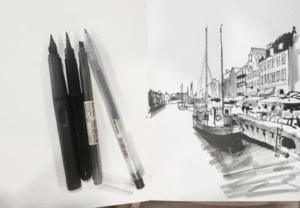
Great advice! Thank you! I love the illustration at the beginning of this article. I find it motivating. Do you have any other examples to share?
Thanks again,
Ann
I’m so pleased you enjoyed the drawing, Ann, and good to know you’d like to see more.
Will
thank you so much Will, for all your wise tips , warm messages. love reading them all. it’s almost like you are talking to us in person!!
Thanks, Yuen, so glad you enjoyed them.
Cheers,
Will
Hi Will.
Thank you for giving the discipline of practice the boost it needs; when a dear mentor encourages practice, we want to JOIN him on the journey. It’s a bonus that our work improves as well.
Thank you also for shining a light on the fact that others tend to see us in a perpetual state of artistic bliss. If they understood the work and the fact that we put our SOULS into each piece, they’d give us more respect. (and they’d deliver baked treats to us to keep the momentum going!!!)
Yes, Lori, delivering freshly baked treats to keep the momentum going sounds a fantastic idea!
Hi Will,
In another world where I’ve worked in technology I’d always tell my team if they were struggling with a particular bug, and the night was closing in, to go home, be sure to eat, and sleep on it. It worked every time where they came in the next morning and had the bug figured out. Thanks for the reminder that the same idea applies to creating art. We have to give ourselves a chance to process what we’re dealing with, and things turn out much better when we do.
-Laura
Cheers Laura, interesting to hear how the same approach can apply to different fields.
Thank you Wii,
I can’t believe what you wrote because a couple of nights ago I sat in bed sketching out, in black an old faded photograph of prickly pear cactuses that I took in Arizona eons ago. I was trying to get the shapes and sort out as to which ones to paint. What to keep what to let go. I had a great sleep and now my blank canvas is calling! However, tonight I will look at potential background colours.
Thanks again.
So pleased it was good timing for you, Marianna. Glad you’ve been enjoying the late night sketches!
Great advice as always Will. It’s so important to do some sketches as preparation before actually starting with the paint. Also as one of the other comments says sometimes nature needs its composition adjusting before you start painting, & sketching helps show what works best.
Definitely John, glad you enjoyed it.
Gosh! What a revelation! I have always been a ‘dive in’ sort of person (and spoiled many pictures because of it)! Thank you so much for the advice which makes so much sense. I am really excited to plan my next painting!
That’s so great to hear Jane, hope you enjoy your pre-planning sketches!
Will
I work better in the mornings and switch off at night so will not be joining your club. Also I like to preplan what I am going to do at the next fortnightly local u3a Painting Group. For example in 2 weeks time the next session we are learning to paint a Winter Landscape scene using new Mixed Media using Acrylic and Oil Pastels which I have never done before. I need to find a suitable a landscape to sketch and paint and make sure I have all the necessary materials eg some new oil pastels . Might call it my Morning Sketch Club.
Enjoy your next session of your Midnight Sketch Club
Cheers Keith
What a fab idea Will to do a sketch at night, sort out what’s needed and then ‘sleep on it’. Letting our subconscious inner creativity truly help us…love it! Surely this will help bring out our best. Thank you for another insightful and interesting newsletter :)
My pleasure Connie, Hope you enjoy experimenting with your sketches.
Will
Hi Will
I did a sketch I was ‘quite pleased with’. Left it on my Art table for a couple of days then got the paints organised.
That’s when I realised I’d made soup with the items in my sketch!
Ha, ha, sounds like it went from a realist to an abstract piece!
So pleased to read all these replies Will, i will join your happy throng. I do appreciate your enthusiasm for painting and most particularly, your sharing and encouraging. I am a morning person, mostly my sketch books are filled with spring and summer sketches with the time I finished them usually about 6.45 when a break for coffee is required etc. However these dark and tempestuous mornings I find Im oversleeping ….after a night of three hours awake! A good time to plan a painting! What a good idea. I will let you know how I get on. (This is not the time to talk about the time I just sat outside staring at the sea and then used up an odd shaped canvas which went to London eventually!) Thanks once again for your encouragement.
My pleasure, Barbara, nice to have you along. And yes, any time is good for sketching. And I think when you take the pressure off to make it a finished piece, but have it as more of an exploratory study, it can really help free up your initial sketches and then inform more detailed studies.