Art Studio Lighting Design (how to avoid being kept in the dark)

cezanne artist studio

Natural light in Cezanne’s artist studio

Have you ever been half-way through a painting and suddenly the art studio light changes?

You carry on painting, hoping for a break in the weather, trying to remember the colour you’ve just mixed, and then the lighting changes.. again.

You think it won’t matter, it’s not that important, but the way you light your art studio can be one of the most cost effective ways of improving your painting and your colour mixing without buying another tube of paint.

One of the easiest methods of designing better lighting, is to simply change your light bulb.

But not all studio lamps are created equal.

From a £5 hardware store fluorescent tube to a £1,500 bespoke solution, the choices you make affect your ability to match colours accurately, judge skin tones effectively, and even feel a little happier by the quality of light you paint within.

With different options available you can have studio lighting the Old Masters would have been proud of…. without turning to shots of Absinthe.

Emergency chocolate biscuits needed

Trying to understand all the considerations when choosing my own studio lighting nearly led me to a lighting melt down! But bear in mind, I’m trying to design a bespoke studio where I’ll be painting 12 hours a day some days, through gloomy British weather and many a midnight painting session. So I need a space that has both natural light and the best quality artificial light.

There are so many variables and it’s such a specialist request that many Electrician’s will roll their eyes at you. With this tricky subject in mind, I have tried to created a summary of what you really need to know, and it can get a bit technical in places.

Do I really need to know this? I hear you cry!

Maybe, maybe not.

It depends on how much painting you do and your current lighting situation…

Continue ReadingArt Studio Lighting Design (how to avoid being kept in the dark)

Acrylic Palette Knife Painting Techniques – Part 4

personal style in painting

Bringing Personality to your Painting

In the final stages of any painting, it’s a case of viewing your piece as a whole and adjusting details or adding more saturated colour to create a harmony and balance.

You’ll be painting more instinctively, rather than methodically and putting a stamp of your own personal style within it.

Students often ask, ‘How do I develop my own style?’

And the answer is quite simple.

You already have it – even though you might not think it…

Continue ReadingAcrylic Palette Knife Painting Techniques – Part 4

Acrylic Palette Knife Painting Techniques – 3/4

paletteknifepaintingpart3

A step-by-step Palette Knife Acrylic Painting – Video Course Part 3

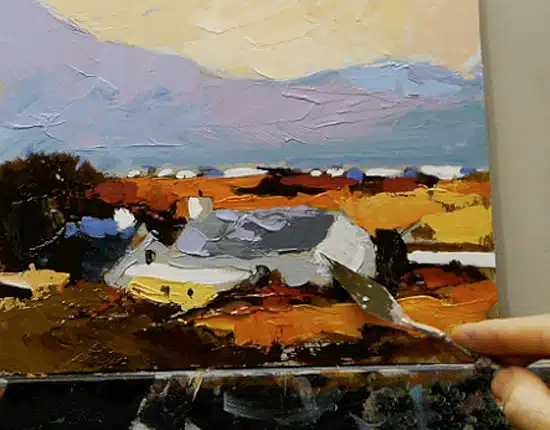
In this painterly, impressionistic palette knife study, I am posting a weekly video on my YouTube channel so that you can follow along at home.

It’s free to subscribe to the blog to receive updates so you can keep up with the painting progress.

Developing a Painterly Approach

When painting with a palette knife, one of the most valuable techniques you can apply is to loosen up and try and see shapes, rather than details.

If you’re coming to painting from drawing, comparing the control you can achieve with a sharp pencil with the ‘clumsiness’ of a palette knife, can be become your Achilles heel…

Continue ReadingAcrylic Palette Knife Painting Techniques – 3/4

Acrylic Palette Knife Painting Techniques – Part 2 of 4

impastopaletteknifeacrylicpainting

A step-by-step Palette Knife Acrylic Painting – Video Course Part 2

In this painterly, impressionistic palette knife study, I am posting a weekly video on my YouTube channel so that you can follow along at home.

It’s free to subscribe to the blog to receive updates so you can keep up with the painting progress.

The reference photograph and full material list can be found on Part 1 here.

The photo can be ‘right clicked’ and ‘Save image as’, so you can use it as a reference, print it out and follow along with the video below…

Continue ReadingAcrylic Palette Knife Painting Techniques – Part 2 of 4

Acrylic Palette Knife Painting Techniques – Free Video Course Part 1 of 4

acrylic palette knife techniques

Palette knives are seen as a sign of confidence in a painter; you can wield them with gusto, paint impasto, and when no-ones looking, you feel like Van Gogh or maybe Bob Ross!

They can have a reputation of being good for certain ‘effects’ or ‘tricks’, for example, painting a snow-capped mountain (and it’s true – they are!).

But often, they are left in your paint box, and you’re not sure where else they fit into your paint practice.

The humble palette knife is used to mix nearly all the paint for my paintings, from getting paints out of tubs, mixing tints and shades on the palette, to scraping off any mistakes.

I often favour a medium size, diamond-shaped blade with a cranked handle – RGM 45 is my favourite tipple (sometimes referred to as a painting knife due to the angle of the cranked handle – see picture below)

It’s a good size for most mixes, and I also paint with it, helping to keep my tools down to a minimum.

I’m overly attached to mine, but what can a good painting knife do for you?…

Continue ReadingAcrylic Palette Knife Painting Techniques – Free Video Course Part 1 of 4

Glossary of Acrylic Painting Terms – The Ultimate Guide for Beginners.

acrylic painting terms glossary

Ever come across a painting tutorial and been stumped by new terms and phrases?

What is an Interference colour? Or a Tar Gel?

Inspired by one of the art school’s readers (cheers Carl!) I’ve compiled a guide to the most commonly used terms in acrylic painting.

Glossaries for oil painting, colour mixing, styles and movements are coming soon (sign up for free email updates so you don’t miss out)

Lets get going!..

Continue ReadingGlossary of Acrylic Painting Terms – The Ultimate Guide for Beginners.

Golden Heavy Body vs Open Acrylics Paints Review

openacrylicreview

Which is Best?

Imagine the scene.

You’re halfway through your painting, it’s going really well.

This could be your breakthrough piece, a personal Mona Lisa.

A quick look on your palette and you spot the perfect mix to finish the piece, you dip the brush in with vigour, and guess what?

Its dried on the palette.

You then try to mix more of that exact colour,

2 minutes goes by, then 5 minutes, when we hit 10 minutes and review our mixes, the initial colour has become a distant memory.

Emergency tea break with chocolate is needed.

So what’s a painter to do?..

Continue ReadingGolden Heavy Body vs Open Acrylics Paints Review

How to Paint like Monet – Part 1 of 4

how to paint like monet

Lessons on the Techniques of the Impressionists

A step-by-step Impressionist Acrylic Painting

How do you achieve a more painterly impressionistic approach with acrylics?

In this series, I will be posting a weekly video lesson that you can follow along at home. It’s free to subscribe to the blog to receive updates so you can keep up with the painting progress.

The first technique in mastering an impressionist style of painting is in the actual name itself,  ‘Impressionism‘.

We are trying to achieve an ‘impression’ of the subject, rather than a detailed copy, so squinting your eyes at the subject, to blur the details is one of the first tricks to adopt.

This tutorial is ideal to leave some of your fears at the door, have fun and loosen up a bit, ready to get started?…

Continue ReadingHow to Paint like Monet – Part 1 of 4

How to Choose a Paint Starter Set for Beginners

(Without making an Expensive Mistake)

dry paint pigment

With so many paint colours available and new ranges being released every week, which colours should you buy when you first start painting?

The overwhelming feeling that descends when trying to buy paint colours either online or in your local art store can often lead to the safe bet…

The pre-boxed starter set.

The paint companies have designed them to help you, right? The best paints for your needs when you are just beginning…or so you would think.

But are they a good choice?

Are you getting the best value for money or are they sending you down the wrong path? I’ve devised a simple technique to help you decide which starter palette is right for you.

Ready for a little paint history lesson to understand what you should be thinking about on your next trip to the art store?…

Continue ReadingHow to Choose a Paint Starter Set for Beginners

How to Paint a Warm & Cool Still Life Painting – 3/3

using acrylic glazes

A step-by-step warm & cool still life acrylic painting  using only 2 colours

This is the final post in this limited palette painting series using acrylics, I have been posting a weekly video on my YouTube channel so that you can follow along at home. It’s free to subscribe to the channel so you can keep updated with the painting progress…

Continue ReadingHow to Paint a Warm & Cool Still Life Painting – 3/3

How to Paint a Warm & Cool Still Life Painting – 1 of 3

acrylic still life warm & cool colors

With only 2 colours

You know the scenario,

You decide to paint a simple study of a lemon; the painting starts out okay until you get to the fun bit, the yellow of the lemon.

As you begin to stare at the yellow to try and judge it’s the intensity you ask yourself  – how yellow can you go?

The more you look, the more you convince yourself that this is most probably the most yellow yellow the world has ever seen, so only the strongest, brightest lemon yellow will do, straight from the tube.

You paint it on with enthusiasm, only to reflect on your handiwork and find the results are a bit disappointing, it looks too fake, dare you to say it, too lemon.

So what can you do?..

Continue ReadingHow to Paint a Warm & Cool Still Life Painting – 1 of 3