

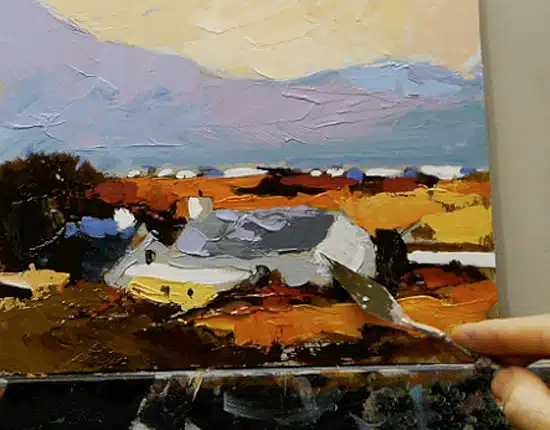
Palette knives are seen as a sign of confidence in a painter; you can wield them with gusto, paint impasto, and when no-ones looking, you feel like Van Gogh or maybe Bob Ross!
They can have a reputation of being good for certain ‘effects’ or ‘tricks’, for example, painting a snow-capped mountain (and it’s true – they are!).
But often, they are left in your paint box, and you’re not sure where else they fit into your paint practice.
The humble palette knife is used to mix nearly all the paint for my paintings, from getting paints out of tubs, mixing tints and shades on the palette, to scraping off any mistakes.
I often favour a medium size, diamond-shaped blade with a cranked handle – RGM 45 is my favourite tipple (sometimes referred to as a painting knife due to the angle of the cranked handle – see picture below)
It’s a good size for most mixes, and I also paint with it, helping to keep my tools down to a minimum.
I’m overly attached to mine, but what can a good painting knife do for you?…
Overcoming the fear of ‘wasted’ paint

When you’re first starting with acrylics, it can be hard to judge just how much paint you should or could use. Once you’ve invested in some artist quality paints, a natural reaction is not to put too much out on the palette and waste them; however, I’ve seen some pretty impressively full paint boxes that produce thin, translucent, almost careful paintings. That lack energy, expression and …paint!
Using a palette knife instead of a brush to actually apply paint to the canvas introduces you to texture and thickness of paint and puts you out of your paint squeezing comfort zone.
With all this in mind, I wanted to put together a 4 part free video tutorial that would teach you new skills, combine using a palette knife with your brushes, and decide when to swap between them.
You’ll create a lovely textured, painterly study that will unlock the joy of painting (and now you really will feel like Bob Ross!)
Part 1 of 4
Downloading the reference photograph
The photo below can be ‘right clicked’ and ‘Save image as’, so you can use it as a reference image, print it out and follow along with the video below.

Materials you will need:
Palette Knife
- Medium size, Diamond-shaped, cranked (angled) handle. I demonstrate with an RGM 45
Brush
- Size 4 black hog brush filbert (from Jackson’s Art)
Support
- 8 x 10 MDF Board primed with 2 coats of acrylic gesso & 1 coat of coloured ground of Raw Umber & Titanium white
- Kitchen roll
- Clean water
- Tear-off palette or stay-wet palette
Paints – The colour palette
Artist quality acrylic colours ( I’ve used a mix of Golden Heavy Body colours & Winsor & Newton Artist Acrylic)
- Titanium White
- Cadmium Yellow Light
- Alizarin Crimson Permanent (W&N)
- Ultramarine Blue
- Burnt Umber
How to paint with a palette knife – Free acrylic video Course |Part 1
The video below shows the first steps I take to start the painting process of this palette knife landscape study.
Make sure to subscribe (it’s free) to keep updated; you’ll get email updates when the next video is posted.
Next week, for Part 2, we’ll start to add the blues to balance the browns and do some freestyle colour mixing.
If you want to brush up on your colour theory, you should look at my Simple Colour Mixing Course.
You might also like:
1. Acrylic Palette Knife Painting Techniques – Free Video Course |Part 2
2. Acrylic Palette Knife Painting Techniques – Free Video Course |Part 3
3. Acrylic Palette Knife Painting Techniques – Free Video Course |Part 4


Wow…that was fantastic! This is what I have been looking for forever. What a fab teacher you are Will. I could listen to you and watch your handy-work endlessly.
Thanks so much! Montreal, Quebec
Hi Sherrill, you’re welcome, thanks for your kind comments.
Cheers,
Will
Great work Will, and much appreciated
Thanks Angie
Looking Good so far thanks
Cheers Dan
Thank you so much Will for this excellent tutorial. I don’t really know the reason why but I seem to be scared to try using palette knives. You make it look so easy though, that I shall just have to give it a try-out.
You’re welcome Nuala, palette knife’s can have that fear factor attached but they can be so easy to use, looking forward to hearing how you get on.
Cheers,
Will
Hi Will,
I have found all your tutorials very easy to watch and absorb, think you do a really fabulous job and i am so excited to see these palette knife painting techniques as more and more it seems to be the technique I am most comfortable with. It was a great relief to see that you combine brush and palette knife and I am looking forward to the next 3 instalments.
thanks again
Pippa
Hey Pippa, that’s great to hear. The combination between the brush and the knife can really make a difference to a painting that has refinement, yet a painterly style.
Cheers,
Will
Such a great teaching style…many thanks!!!
Cheers Robin
I can hardly wait going now to buy more paints.B-) many thanks
You’re welcome Cate
Thank you.
Anxious to see part 2, 3 and 4
Thanks Donna, yes, the next stages start to get exciting!
Cheers,
Will
Absolutely loving this, Will, thank you!
Good one Shelly
Verygood intro. Can’t wait to see the rest of them. Thanks.
Thanks Joe,
Will
Will, I can’t express my gratitude enough! You give such clear, understandable instructions, with such a great sense of what the beginner experiences! Thank you for relating so well, and for being there to help! You give me hope!!!
Hey Richele, very kind of you to say so, sometimes all your paintings need is a little hope!
Cheers,
Will
Thank u so much for sharing, can’t wait for the next lesson, much appreciated
You’re welcome Annelise, thanks for the comment.
Cheers,
Will
After working through your colour mixing course, I found this tutorial just what I needed to give me the confidence to attempt even more adventurous paintings. Your explanations are so clear, it is a pleasure to work through your tutorials with you.
Oh Hi Helen, that’s great to hear.
Thanks,
Will
Thank you so much! You are a great teacher and I love the way you share your knowledge, have already learned so much. Looking forward to the next video!
You’re welcome Catharina, thanks for your kind words.
Will
Thought I had lost my “mojo” till I discovered your website. You are simply awesome. Show me more!!! Thank you so very much for sharing your skills, knowledge and enthusiasm. Bring on the next video.
Cheers Cheryle, great to hear you’ve re-discovered your painting mojo!
Well thank you again for making it all look so easy. I had a go at the weekend, though with a still life that I had found as I am trying to provide ‘art’ for my walls in the bedroom. What fun! I just needed another week to spend on it. THe use of palette knives really forces you to loosen up and not be too precious. I think I now need to invest in the mediums to make the paint more textured, so it’s time to get my Jacksons catalogue out! Thanks Will :) x
Hey Ali, nice to hear from you, glad you’re enjoying using your palette knife!
Cheers,
Will
Hi Will
Taking a winter’s break from my art classes (in French!). I fear much has been lost in translation! Now I’ve found you, everything is falling into place. Can’t wait to see how this one progresses… and dying to give my palette knife a try. My teacher will be mightily surprised come the start of lessons in spring!
Abbie
Ile de Re, France
Hi Abbie, go for it with the palette knife! You’ll be a palette knife pro by spring.
Cheers,
Will
It was amazing! but I am waiting for your acrylic ‘Simple Colour Mixing’ course
because I am having a great trouble.
Hi Pruthvik,
Glad to hear you’re enjoying it.
Cheers,
Will
love, love, love your work. I have learned so much. Is there a way to download your free videos. I go to the cottage in the summer and there is no internet there. I want to take my paints and do your lessons there. Thanks, you have made a real difference in my work. Nan
Thanks Nan,
If you’re on Firefox as a browser, you can download an extension called Easy You Tube Video Downloader
Once this is installed you can really simply download the video and any other you tube video, so you can work away from the internet.
Cheers,
Will
Been watching your youtube videos and appreciating your painting AND teaching skills. A hundred years ago, I worked in oils but had to quit because children+oil paint odors minus studio space isn’t an option. Acrylics seemed impossible. Now-thanks to you-I’m learning of their versatility, but never considered palette knife painting. How fun! Thanks for your time and insight!
Thanks Amy, using acrylics with a palette knife can really highlight their versatility.
Will
I have really learned a lot from your videos. My husband bought me the coloring mixing course as a gift and it is fabulous.
Thank you.
Hi Iris, nice to hear from you, really pleased you’ve been enjoying the colour mixing course, when you’ve finished one of the colour studies I’d love to have a look.
Cheers,
Will
Thanks Will for another great lesson, you give so much of your time and explain things so well, I am just one of the very many who appreciate what you do, I cannot wait to get started.
Cheers Isabel, looking forward to seeing your results.
Will
Well done Will for keeping us all awake.No shortcuts to becoming a good ‘artist’.
Cheers Jonathon,
New techniques always help to keep your paintings fresh, hope you enjoy the course.
Will
Hi Will, thank you so o o much for the video lesson. So nice of you to send it free to us! Looking forward to the rest of the tutorial. I will now take courage to work with a palette knife, now that you have shown us how :-) One question, what do you use as your colour palette? And how does the paint stay put when it is vertical? Bye Prabha
Hi Prabha, great to hear you’re enjoying the lesson.
The paint stays vertical because it is a heavy body paint and isn’t liquid enough to slide down the palette. I usually work with the palette horizontal, however, for demonstrations it’s easier for you to see the mixes side by side. I’m using a tear-off palette.
Cheers,
Will
Thanks Will for your prompt reply, er.r.r. what is a tear off palette? Prabha
Hi Prabha, a tear-off palette is a palette made of about 50 individual sheets of parchment that are disposable after you use them. So you lay your paints out, finish your painting session, ‘tear off’ the sheet and place in the bin and then you have a fresh sheet to work onto next time without any washing up!
Here’s a picture of a tear-off palette.
You can use them for acrylics or oils,
Cheers,
Will
Hi Will
Just spent the day painting with my friend. We had a go at acrylic, this was really helpful. Loved it. Can’t wait for the next video
You have a great ability explaining things
I am really enjoying watching you paint.
Brilliant.
Thank you
Jane
Hi Jane, thanks for dropping by, great to hear you’ve been enjoying the videos, next stage coming in a few days!
Cheers,
Will
Hi Will! Happy New Year! You are a great teacher; and I love your work. Thank you for sharing it with me!!!
Thanks very much May, pleased you’re enjoying the lessons,
Cheers,
Will
Wonderful, clear instructions, thanks so much, very much appreciated.
Can hardly wait to grab my painting knife and have a go at it.
Thanks Judy, looking forward to hearing how your painting turns out.
Cheers,
Will
Thank you Will for another great tutorial. You are a truly gifted artist and teacher.
Thanks very much Abby,
Cheers,
Will
OH yes I will be so excited to work with the palette knife something new to use in the biggest part of the painting, I so loved how you taught me the still life cherry painting. I was really glad I did so well if I could I would send a photo but not sure how send it,I did the painting with cherries in a row, I know funny I called it three in a row. Thank you for your wonderful lesson
Thanks Virginia, really pleased you enjoyed the cherry tutorial. I’ve just received your cherry picture, so thanks it looks fab.
Cheers,
Will
Complimenti sei bravissimo e grazie soprattutto dei tuoi video free.
Giuseppe
Congratulations and thanks for your very good free video.
Giuseppe
Grazie Giuseppe, sei stato felice godendo le lezioni,
Cheers,
Will
Thanks Giuseppe, pleased you’ve been enjoying the lessons,
Cheers,
Will
Your work here is a beginner’s dream: clear, direct, confidence-inspiring.
Helping us out of the murky self-conscious doubts that quickly pile up into a whole lot of procrastination and no painting at all!
Thanks!
Hi Sergio, thanks very much. really pleased you’re finding the tutorials helpful. Looking forward to hearing how your paintings turn out.
Cheers,
Will
I was bought a set of palette knives for a Christmas present .now I get to know how to use them ,always wanted to paint mountain scenes. I have used the old credit card trick for rocks and boulders that was ok. so thank you TAHolland.
Cheers Thomas, glad to hear your new palette knives will be getting a workout!
You should get some more refinement and control with using the cranked handle.
Enjoy experimenting,
Will
Hi Will…I’m new to painting began with paint with numbers enjoyed it so much that I wanted to do my own. Then I discovered Will Kemp and learner ALOT. But I’m having a difficulty with painting shaded areas ie. mountains and forests. It doesn’t look natural. Any suggestions? Thanks for doing what you do!!! p.s. I hope you and yours had a wonderful time in Paris.
Hi Louis, pleased you’re enjoying the site.
Forests and mountains usually look unnatural due to the colours being too intense, for example a vivid green.
Most colours in nature are actually very muted. Try mixing a green with a burnt umber or black & cadmium yellow, it will give you a very muted greenish hue and you can build up the painting tonally this way.
Have a look at this video to see how different greens can vary greatly in intensity.
Hope this helps,
Cheers,
Will
Hi Will,
Thanks for these great lessons. The boards I have purchased say they have already been treated with gesso. Do I still need to add two more layers of gesso? I am ready with paints and knife, awaiting your response!
Kathryn
Hi Kathryn,
Nice to hear from you, if the boards already have gesso applied you don’t need to apply any more gesso. Just add the coloured ground colour with thin acrylics and you’re good to go.
Cheers,
Will
How do again Will
in regards to a still life and a painting knife is there a convention about consistency of use across each element? I have used a knife on a jug to create a particular texture but not on the fruit around the jug.
From a distance of 4 or 5 paces the various textures are not easily discerned, but standing next to the canvas I have wondered. I sorta of think ‘no problem’ because the texture of the jug and the fruit in reality are different, so Ive just maintained the difference but in a different way!
Cheers
john
Hi John,
There isn’t really a convention or specific rule regarding the different textures of objects when working with a palette knife.
If anything, having a different texture/application for a different object helps to separate the different elements in the piece.
For example, a thinner, smoother application for a ceramic bowl compared with a rougher, more organic nature to a piece of fruit.
Trying to match the texture on your painting with the physical texture of the objects can be a subtle way of achieving a sense of realism in your still life painting – even if the application is quite abstract.
Cheers,
Will
Thank you for this- again like I mentioned when I stumbled on your site to learn the ways of gesso, I’m now crawling back to play with pallet knives. Mainly due to frustrations on some mountains I was trying to recreate. (Which is ironic because I live in a state that’s sea level- fabulous right? Lol) but I constantly ran into the problem of my rocks being too smooth. If it was a smaller more landscape set of mountains in the horizon I could cheat (and have) but I almost broke down crying.
Glad I didn’t and decided to browse your tutorials again!
Though I do have a quick question, will there be a major difference between using a plastic knife over a metal? I picked up the inexpensive plastics for now, mainly because I’m unsure of what I’m doing, but will these hinder a painting or are they like most things you buy at the big box craft stores, meant as a student beginner tool?
Thanks again for all that you do!
Sam
Hi Sam,
I’ve found the metal knifes have more flexibility and a finer edge than the plastic knifes, so won’t necessarily hinder the application of the paint on the canvas but will change the paint mixing on the palette slightly.
Cheers,
Will
Very few Artist share techniques thru Demonstration.
Your kind hearted ness will always be appreciated and learned a lot from you way of teaching.
Thanks you Will Kemp.
Yusuf Aidroos.
Thanks for your kind comments Yusuf.
Cheers,
Will
Hi Will ,
It is an amazing detailed palette knife lesson ,I like the way you teach ,you exactly know what we need to know and that makes you different and outstanding among the others .
I have a question for you .Would you please let me know what kind , size , of palette knife do I need as a beginner ?
Many thanks in advance
Jahangir
Hi Jahangir, pleased you enjoyed the lesson, I demo with a size 45 palette knife by RGM which is 55mm in length
Cheers,
Will
Hello Mr. Will. I am from Mexico and I thank you for such a great web site for paint students. I want to learn from you. I have only about 3 hours per week to paint, so I it will be kind of slow, but anyway I plan to enjoy it. Than you again for your kindness to teach what you know. It Will be rewarded from heaven.
Kind of you to say so Antonio, great to hear you’ve been finding the tutorials helpful with your paintings.
Cheers,
Will
I loved to watch your palette knife techniques. I have tried palette knife and would like to learn more. Thanks for the demo.
Pleased you enjoyed it Purnima,
Cheers,
Will
WillI can’t tell you how excited I am to start my passion for painting .Your palette knife tutorial was awesome. Great techniques! What flexibility an artist can get i was not aware off.
Thanks a million
Love this new method. Want to know more. How can i view the other videos?
Hi Rinus, there are links at the bottom of the article to the other lessons in this tutorial.
Cheers,
Will
Hi Will!
First off, excellent video course – you’re a wonderful teacher.
Question: Is MDF used in this course because of the amount of acrylic paint being applied? Can birch or heavy duty canvas (12oz cotton) be used instead?
Maria
Hi Maria, pleased you’re enjoying the lesssons, a board is used so you have something hard to press against when using the palette knife. As you get more experienced you can use the same techniques on canvas, but working on a hard surface is easier when first starting with a palette knife.
Cheers,
Will
I’ve done some but using oils probably can use the same techniques right?
Yes, you can use many of these techniques with oils, you will just have a much longer drying time due to the thickness of the application of the paint with the palette knife.
Cheers,
Will
Thanx 4 this info on pallette knives. It will greatly have an influence in my art studies at MCCC.
Take Care and may God Bless
Al
Good one Al, pleased it helped.
Will
I am enjoying your videos and appreciate the time and energy you share with those of us eager to learn. My question is – When using a pallette knife in a painting does one have to finish the painting within a specific period of time e.g.,that day or within a few hours. If so, how would I fix something that doesn’t look right once it has dried? Hopefully this does not sound too stupid a question!
Hi Lynn, so pleased you’ve been enjoying the videos.
My question is – When using a palette knife in a painting does one have to finish the painting within a specific period of time e.g.,that day or within a few hours. If so, how would I fix something that doesn’t look right once it has dried?
Once standard acrylics are dried you won’t be able to rework them, whether you apply with a palette knife or brush. The thicker the application the more the initial working time of the paint. Some specialist acrylics like Atelier Acrylics, have an ‘unlocking formula’ so you can re-wet the paint but it still won’t make thicker impasto paint the same workability as its drying off.
Cheers,
Will
Hi Will,
I’m just starting out in painting & im very pleased I found your site, it’s very informative & next year I’ll be enrolling in one of your beginner classes (which I’m pretty excited about)!! I do have some questions though & that is, do you do impasto techniques & is this easy for a beginner? I’m still trying to work out my style, but I do like the palette knife Painting technique
Hi Donna, this lesson with the palette knife is the most impasto lesson. You would be able to do it as a beginner as an exercise to see how far you can push the impasto to then judge wat style you prefer.
Cheers,
Will
Hi Will,
I’ve thoroughly enjoyed your videos and the bug has bitten me once more as I’ve been going through a un-inspirational period just lately…I looooove working mainly with my knife… but i occasionally defer to brush. My style is very emotionally abstract and expressive but I find it takes a lot of research about an image that transfixes me and then I have to learn about it and after a while images appear in my mind of how I want to portray what I feel.
Thankyou so much for all of your information, its truly inspiring when I feel I have nothing to express on canvas,
Regards
Piggy
That’s so fab to hear, so great that you’re feeling inspired in your work again Piggy.
Cheers,
Will
Hi Will,
I loved this demo and I’d like to try my hand at palette knife painting myself. The problem is I don’t have heavy body acrylics, is it possible to use regular ones? Mine are Daler Rowney “GRADUATE Acrylic” paints.
Thank you,
Ala
Hi Ala, yes, you can use graduate paints, you might need to use a little more paint to cover over some of the colours.
Will