


One of the most common questions students ask me is: “How can I paint looser?” Many students want to know how to loosen up their painting, especially if they tend to get stuck in careful details.
But loose painting is rarely the starting point.
In my experience, what often looks loose on the surface is actually controlled simplification underneath. Learning to paint with control first makes a far stronger ‘loose’ painting later on.
Messy and loose can look similar at a glance.
Structurally, they are completely different.
Loose painting is confident editing.
Messy painting is an undecided execution.
That difference in how they are constructed changes everything.
The hidden structure
If you look at painters like Sargent or Sorolla, their work, on the surface, feels fresh and spontaneous. The brushstrokes seem almost casual.
But slow it down.
The drawing is solid.
The values are clear.
The edges are intentional.
And also, let’s not forget the scale. When you’re first starting out and most probably painting small, 20 x 25cm, or in sketchbooks, you can flick through images online and think, ” Wow, how do those paintings look so luscious and painterly, yet still hold that accuracy?”
But the scale of the painting can really help.

Sewing the Sail, Joaquín Sorolla, 1896, Oil on Canvas
Sewing the sale is 3m x 2m. It’s huge!
When you go in close, what appears to be a small element in real life is pretty large. This section is approximately 30cm x 20cm.

It feels possible to create a copy of this section of the painting at this scale. A ‘leaf’ is a solid block of colour. No details, no clever blending. The dark values are built up on top; depth is created through the paint’s physicality.
Sorolla could paint tightly if he wanted. In fact, in many areas, he does.
Faces are often carefully resolved. The surrounding passages are simplified.
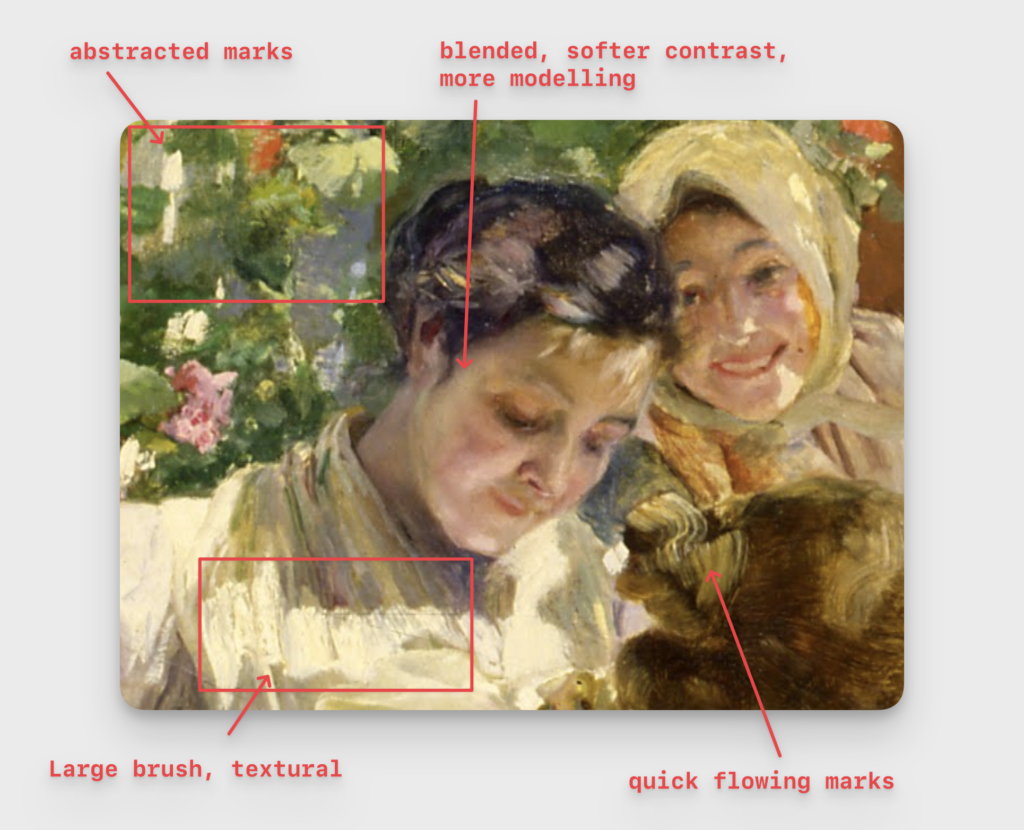
In this small section of the painting above, there’s a surprising range of brushmarks, shifting from quite realistic passages to moments of near abstraction.
Notice too that the brush used for the flowing locks of hair is much larger than the one needed to model the forms of the face.
That apparent looseness succeeds because it rests on a solid structure. The drawing is sound, the values are organised, and the colour harmony is considered.

You can see in the black-and-white version that the light bounces around the scene, and the flowing hair at the bottom right still ‘reads’ as hair. And the abstracted loose brushwork around the face becomes more apparent.

When we blur the image, the colour harmony still works. We can imagine two figures; we can piece together the scene with no details, no edges, no brushwork.
If looseness doesn’t feel convincing, it is usually because the drawing is uncertain, the value relationships are unclear, or the brush marks are reacting rather than deciding.
Loose painting is not a lack of control. It is controlled with information removed.
The Impatience Impressionist
Now, I know what you might be thinking: “Well, this all sounds great, Will. Get tighter, get more accurate, and then it will flow.” But what if I wanted to paint something today? What if I just wanted to have a go at painting something more loosely?
Okay, if you want to feel the swish of the brush and make some big marks, this is what I’d recommend you do.
1.Paint from life
I’d set something up, really, really basic. Or actually, you don’t even need to set something up. Just find an area in your house, a corner of the room, look outside the window, and find anything to paint. The subject doesn’t really matter. It’s more about the actual practical getting used to making more decisive decisions.
If the subject has a bit of a light object and a dark object, that can help to give you some contrast, but don’t worry about the composition.
2. Position yourself further away than feels comfortable.
If the object is just out of arm’s reach, step back about 2 to 3 times that distance so you can just barely see it. That’s what you want. You don’t want to see any details in your subject.
3. Scale up your brush
Grab the brush you normally would go for, and then try to find one that’s about two to three times as big as that. If you haven’t got an artist brush that big, just grab a decorator’s brush. Even if it’s a rough, wide brush, that’s absolutely fine. It might actually be better than something like a sable that’s smooth.
4. Block in and move on
Then you’re just going to try and block in and paint some of the shapes, marks, and colours you can see, without really worrying about accuracy as much. You’re just trying to get into that flow of making a mark and then leaving it and then coming back to it.
When you try this, your confidence will drop at first, but your awareness will increase. You’ll start to see more clearly because you’re not hiding behind over-measuring or cautious adjustments.
You can learn how to loosen up your paintings by working on these short, freeing exercises.
Painting loose is a balancing act
These two approaches seem completely opposite, and in many ways, they are.
One leans into accuracy so that, later on, you can afford to be looser.
The other leans into looseness so you can clearly see what still needs strengthening.
Both are valuable. Both play an important role in your development as a painter.
Once you’ve built structure and control, though, it’s very tempting to stay there. To repeat what works. To reach for the brush size that feels safe. To follow the process that gives you a dependable result.
But real looseness depends on adaptability.
Make a habit of breaking your own patterns. Try new approaches even when your current method is working well. Change the brush. Change the surface. Add a new colour. Shorten the time.
Deliberately put yourself back into beginner mode.
That repeated willingness to feel slightly uncomfortable keeps your painting alive. It strengthens your decision-making. It prevents your brushwork from becoming mechanical.
When you get comfortable being a beginner again and again, you build something far more valuable than a single “style.” You build flexibility. And flexibility is what allows you to simplify with confidence.
Because looseness is not just about fewer strokes.
It is about knowing you could do more and choosing not to.
You May Also Like:
Here’s a free acrylic still life tutorial that looks at the process: How to Loosen up your Acrylic Paintings – Impressionistic Apples Tutorial
Mastering Brushwork Techniques for Looser Painting: https://willkempartschool.com/how-to-paint-looser-mastering-brushwork-techniques-for-impressonistic-art/


Thank you that is interesting I have just done a painting which was meant to be ‘loose’ but I didn’t quite achieve it.
Hey Norma,
Have a look back at the painting and see, are there specific elements within it that feel loose? You might be able to rework some sections of it so it has that illusion of looseness, even though some areas are tighter and more focused.
Will
Thank you will. Great article.
Thanks Mary
Excellent overview and suggestions Will. Very useful article, as usual!
I recently tried the ‘just start painting’ approach for the first time, on canvas paper taped to an easel. My results were not nearly as good as when I start with a more planned out approach (using the knowledge I gained from your site and courses Will), but doing this exercise has helped a lot to loosen up my painting overall. Plus, the ‘just paint’ approach really is a lot of fun and a great way to spend an afternoon. And I now use much larger canvases than my starting point of 8×10, which has greatly helped me not to fuss so much and avoid (mostly) overworking paintings.
Great article!
Hey Philippe, great to hear that you’ve been practising both different approaches and seeing how they can be incorporated into your own practice.
Will
Hello from Vancouver Island, BC. Thank you so much for article of how to loosen up painting. I’m heading to my little studio now to try these techniques and study your guidance on this.
Great to hear it Lorna, I really hope they help.
Will
Aha! You’ve helped me make the connection of how the artists would go someplace ‘to paint’, but what they were often doing was only starting their paintings (like you’re describing), and then taking them back to their studio and finishing them. So it’s a method that lends itself to a process that can be repeated. I love your posts. Very helpful. Cheers. -Laura
So pleased it helped with a new insight Laura.
Great article, and I am happy to have your advice. Thank you, Will!
Cheers Audrey
Greetings, Will!
I have been a realist painter all my life, and that is my joy in painting when I achieve it. It seems to please my audience as well.
At 87 my eyesight and color perception is failing and I have decided I should focus more on loose, impressionistic, if not abstract, techniques. I found your article very helpful and it gives me much food for thought. I plan to utilize your advice when I paint next.
Your advice is always so good. Thank you ! God bless you.
Martha P.
So pleased you’re feeling inspired Martha,
Will
I echo everything said above. I’m “desperate” to have the skills to paint loosely…you have helped endlessly- again .. and over the last 6 years and as Martha P say “God bless you”
G
Thanks Gill, very kind of you to say so.
Will
What a perfectly timed article, I think I asked this question on another article recently. This is exactly the issue I have, my ‘loose’ just feels messy (although at this point, so does my ‘tight’ brushwork) specifically because I don’t really know how the mark is going to impact the overall piece. And sometimes that randomness is good, it can take you somewhere interesting, but if it’s all the time, you don’t really have confidence in what you are doing and may not end up with the result you intended or are happy with. It’s important to remember that you can still be deliberate while also being loose.
Yes, that’s exactly it, Jonathan. Being deliberate when you’re being loose is the real key to it working well.
Will
Wow, thanks for your help and insight into painting loose.
It’s a challenge for sure.
I have found using a pallet knife helps me at times to paint loosely.
I need to keep practicing with a painting brush. It’s a challenge for sure.
Julie
Cheers, Julie. Yes, palette knife can be so effective. They do feel that you lose some of that control that you’ve got with a brush, and it also encourages you to paint thicker, so yeah, great point.
Will
I am 94 and have always loved painting. It is harder now but I still have a go. I love your articles, thanks Will. Mavis (Australia)
Glad you’re finding inspiration from them Mavis.
Will
Your the best!
Thanks Donald!
Thank you again, Will, such great advice, I’ve just supplied it and it works. Starting slowly and ‘loose’ helps building up the skill, and counterintuitively, builds up confidence. But indeed why so many barriers to creativity ? Take care, Cecilia.
Cheers Cecilia, pleased you’ve been enjoying experimenting.
Will
So very useful and timely as are all your posts. I tend to think “I’m over it” to get on quickly to the next painting, but I know that is just being lazy. I find that ” leave it!” is a much better saying. And the next day fresh eyes usually help. Btw I love Sorolla’s work and his book The Masterworks was a great investment. Kind regards Syl
Yes, so true Syl, the fresh eyes can really help then overworking and losing some of that freshness in the brushwork.
Will
Another Great Article. Many Thanks Will
Cheers Tom, hope you’re keeping well.
Will
Will,
Brilliant article love the explanation and exercise , it is the answer to a long time question , even when you manage to somewhat achieve this , I would always ask ,why is my painting so smooth , where is the texture , brush marks, strokes , spontaneity… then spend time destructing the look …. You give such clarity to this subject and many more
Hey Kim, sometimes you need to experiment in the extremes to see how textural you could get this area of the painting or how smooth you could get another area, and then when you push it to both extremes you can often find the happy medium in between the two.
Will
Interesting article. I just switched to pastels and found my artistic home. Your advice works for pastels too. Thanks.
Thanks Nessa, glad you enjoyed it.
Will