

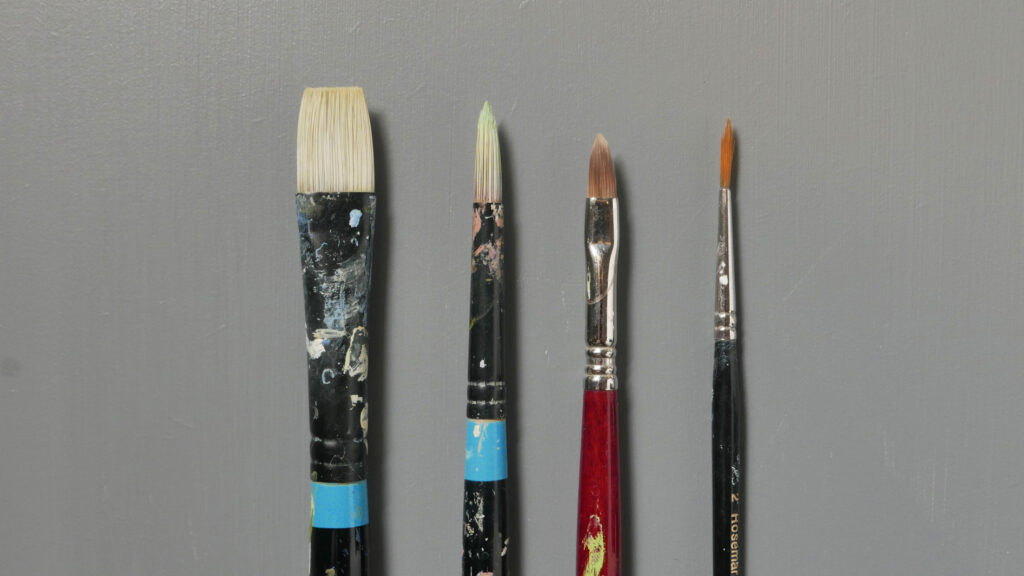
One of the most common messages I receive, is from beginners, asking if they ‘need to loosen up.’
Sometimes they do, sometimes they don’t.
Painting in a loose, impressionistic style has the allure of freedom and artistic and personal expression. But when you’re thinking about your drawing, composition, and colour mixing, achieving fluid and expressive brushwork feels elusive.
So, what can you do to practice? How can you keep a balance between realism and looseness?
The key to looser brushwork lies in mastering the subtleties of your tools and learning how to let go of unnecessary precision.
The 1 Reason Most People Fail at Brushwork
I’ve been practising and teaching brushwork for over 20 years. Using traditional to modern techniques, including long handle, short handle, sable, and hog, I’ve seen first-hand how proficient brushwork can transform your painting, but over the years, I’ve also learned that people who want to achieve fluid, expressive paintings often end up failing.
Approaching brushwork with a mindset of control and perfectionism isn’t the answer. You could think you would achieve more by focusing harder, using better brushes, or spending more time on details, but the truth is that the fear of letting go is holding you back.
One of my favourite brushes does everything ‘wrong’.
Bristles have fallen out.
It doesn’t hold much paint anymore.
The bristles are splayed, and there’s a thick paint build-up near the ferrule.
I love it.
The imperfections in the bristles create unpredictable strokes and texture that a new brush can’t achieve.
(There is a Japanese term called Wabi-Sabi. This is my wabi-sabi brush!)
The secret to loose, expressive brushwork lies in understanding key elements—your brushes, paint consistency, surface, and how you hold the brush.
Whether you’re wondering how to learn brushwork or simply want to improve your expressive painting skills, this guide will show you how small adjustments can make a huge difference.
6 Key Variables That Influence Brushwork
Have you got control issues?
To paint looser, you need to understand the factors that shape your brushwork. There are countless variables that affect the look and feel of your strokes, and tweaking them will help you achieve a more fluid, expressive style. The biggest one is control.
When you move from pencil to paintbrush, a simple mistake will unwittingly hold your loose painting back.
You’re holding your paintbrush like a pencil, not a brush.
The further back along the handle you hold your brush, the less control you have.
The less control, the more loose a brushstroke will be.
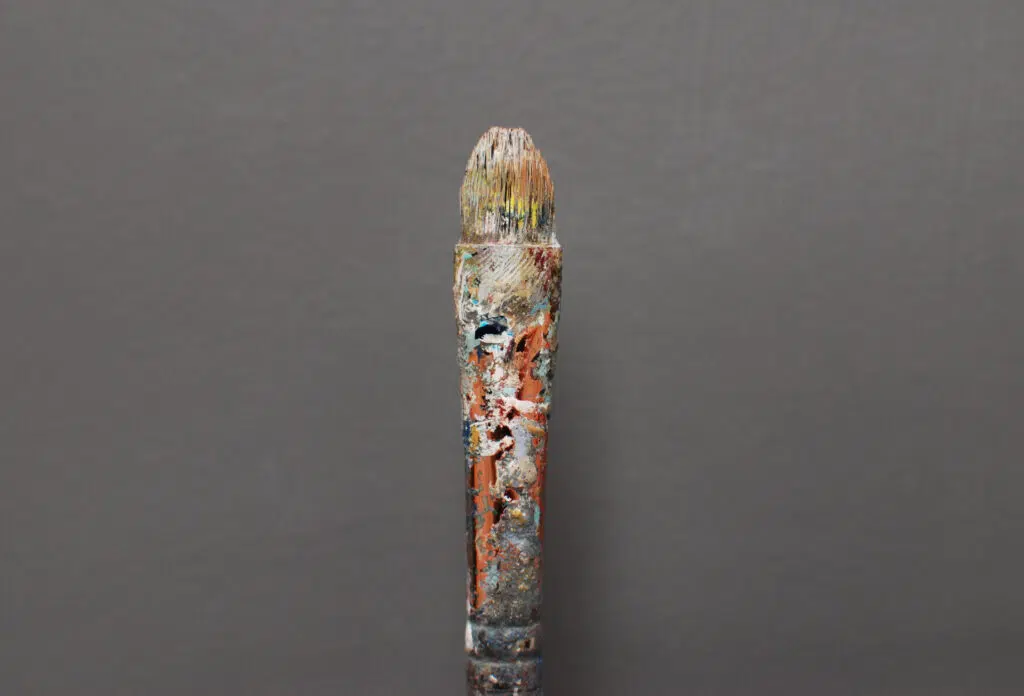
My trusty old brush
1. Bristles: The Foundation of Brushwork
Each brush behaves differently; understanding them is key to creating varied and dynamic strokes. The type of bristles is the most fundamental factor influencing your work; this article looks at the most common bristles used in artist brushes.
- Length and Width of Bristles: A wider brush (in relation to your canvas size) covers more surface area and encourages bigger, bolder marks, perfect for a loose painting style.
- Absorbency: Bristles like sable hold more water, allowing for smoother, continuous strokes, while hog hair brushes tend to release paint more quickly, creating textured, broken lines.
- Snapback: This refers to how much the bristles spring back after being pressed into the canvas. Brushes with more snap create sharp, defined marks, while softer bristles make for smooth strokes.
- Age of the Brush: A new brush behaves differently from an old one. As brushes age, they soften, lose bristles, and create unpredictable marks. Many artists, myself included, prefer older, worn-out brushes because they allow for more spontaneous textures.
- Splay: Match the brush’s splay to the mark you’re trying to create. Imperfections create unpredictable strokes and textures.
Pro Tip: Don’t be afraid to experiment with those worn-out brushes you’ve moved to the back of your studio space—they might just give you the loose, textured strokes you’re after.

Thick impasto paint mixed on the canvas

Thin diluted paint, creating a soft fluid effect
2. Paint Consistency: Thick vs. Thin
The consistency of your paint is another major factor in brushwork. It affects how the paint interacts with your brush and canvas, and how it flows across the surface.
- Thick Paint: Using paint straight from the tube creates bold, textured brushstrokes. This works well for impasto techniques or when you want to emphasize texture and create broken edges.
- Thin Paint: Diluting your paint with water, oil, or a medium will allow it to flow more smoothly, leading to softer, more blended strokes. This is great for glazes or for creating a more fluid, looser style.
- Mixing on the Palette vs. on the Canvas: Fully mixing your paint on the palette will give you a consistent color, but mixing directly on the canvas adds color variation within each stroke, adding depth to your work.
Experiment: Try mixing partially on the canvas instead of fully on the palette. This can help loosen up your brushwork and introduce beautiful colour into your strokes.

Smooth canvas vs textured

Adding surface texture onto the canvas enables looser brush handling and broken edges
3. Surface Texture: How the Canvas Affects Your Brushwork
The surface you paint on—whether it’s a smooth board or a textured canvas—significantly affects the look of your brushstrokes.
- Smooth Surfaces: A smooth board allows your brush to glide, creating clean, solid blocks of color. This is great for controlled work but can feel too tight for looser styles.
- Textured Surfaces: A textured canvas grips the brush, breaking up the paint and creating more dynamic, irregular strokes. This helps when you want to achieve a looser, more expressive feel.
- Absorbent Surfaces: Some surfaces, like raw canvas or watercolour paper, absorb the paint, creating soft edges and a stained look. This is ideal for loose washes or underpaintings.
Pro Tip: If you’re struggling with tight brushwork, switch to a rougher surface. It encourages broken, unpredictable strokes.
4. Speed of Application: Fast, Medium, or Slow?
The speed at which you apply your brushstrokes directly influences how loose or tight your painting looks.
- Fast Brushstrokes: Quick strokes create energy and movement. To achieve looser, more expressive brushwork, practice speeding up your application.
- Medium Speed: A balanced, medium pace allows for some control while still maintaining a sense of flow. This works well when you want a mix of precision and looseness.
- Slow Brushstrokes: Slower strokes are more deliberate and careful, which can result in tighter, more controlled work. However, slowing down for specific details and then speeding up for broader areas can create a lovely dynamic balance in your painting.
Try This: Set a timer and force yourself to make faster brushstrokes during your next session. The sense of urgency can help break your perfectionism or reach for tea and biscuits to calm down!

Close grip giving more control

Loose grip further down the brush gives freer looser strokes
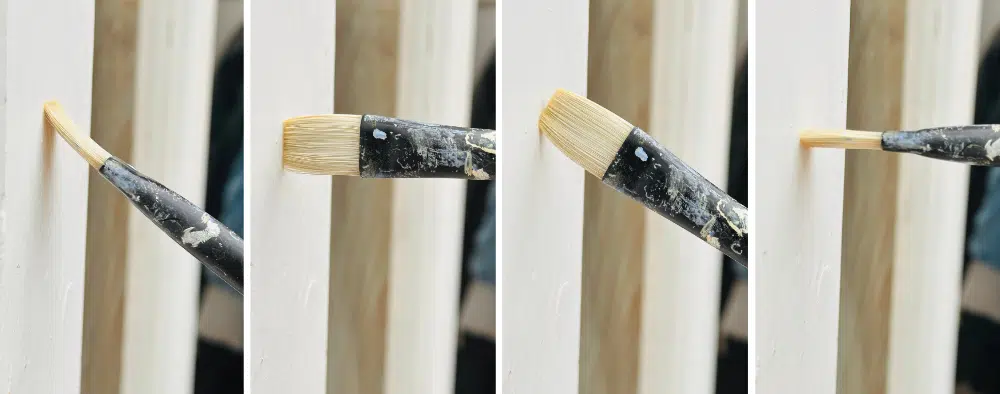
5. Brush Handling: Different Angles, Different Effects
How you hold your brush and the angle you use it, will change the quality of your strokes. Experiment with different grips and angles to achieve various effects.
- Flat, Side, Tip: Using the flat side of the brush gives you broad, even coverage while using the tip creates sharp, precise lines. Holding the brush at an angle or even using the handle to scratch into the paint adds more texture and unpredictability.
- Hand Grip: Holding your brush close to the ferrule gives you more control, but holding it further back encourages larger, freer strokes. You can even extend the handle to force yourself to paint from a distance, making it harder to get stuck in the details.
Pro Tip: Mix it up. Switch between gripping the brush close to the ferrule for details and farther back for broader, looser strokes.
6. Pressure: Strong vs. Soft Application
The pressure you apply with your brush dramatically affects your brushstrokes.
- Strong Pressure: Pushing hard into the canvas creates thick, bold strokes with visible texture. This is great for emphasizing specific areas of your painting.
- Soft Pressure: A lighter touch results in delicate, whisper-thin lines that can soften your overall piece. This technique is useful for transitions and highlights.
- Varying Pressure: Combining intense and soft pressure in the same stroke creates dynamic brushwork. For example, start with heavy pressure and gradually lighten as you move the brush, creating a stroke that fades out smoothly.
Exercise: In your next painting session, alternate between heavy and light pressure within the same stroke to create varied lines.
Putting It All Together: A Recipe for Looser Brushwork
To paint looser, you don’t need to throw out everything you’ve been doing. Instead, it’s about tweaking the variables—the brush, paint consistency, surface, speed, handling, and pressure. By experimenting with each of these elements, you can find a balance that feels more expressive and spontaneous.
Looser brushwork is about embracing the process and using your brush as a tool for expression, not just control. When you learn to experiment, push boundaries, and stop obsessing over the smallest details, your brushstrokes will naturally become freer.
Final Thoughts: Practice Makes Progress
The more you experiment with these variables, the better you’ll understand how they influence your brushwork. Remember, painting looser isn’t about being careless—it’s about learning to trust your instincts, work quickly, and make bold choices.
If you’d like to learn more about how your canvas choice, brush method and paint mixing can all work together, I’ve got a new ‘How to paint like Monet’ launching in the next couple of weeks; whoop whoop!
Look out for the materials list for the course next week so you can loosen up and let your creativity flow.


Wow, you put a lot of effort into this! I’m not an experienced brush handler and read the whole thing twice. What a great lesson. Thank you!
Hope you find it helpful Pat.
Will
Great article! I forget, and go closer and smaller and tighter. I love to hold it long, and switch hands as well.
Hey Theresa, yes, switching hand positions on the brush can make the biggest difference in getting that flow with your brush
You are a wonder! It’s like I woke up today, and you were in my dream.
I found this email from you about loosening my brushstrokes! Just in time
for what I am working on.
You are a master teacher at all the art instruction you choose to convey.
Really, you are one of the elite best. I just thinking—how lucky we are that
you must enjoy and choose to develop lessons for us, in between the joy of creating your own art. Thank you so much for caring about us so much to share your knowledge and experience and skills both in the art of painting and words.
Rozanna ❌
My pleasure Rozanna, so pleased the article was timely for your painting.
Will
Hey, thanks for this! This is a wonderful reminder for me. Do you also have a tutorial on palette knives? Best, Sally
Hey Sally, sure, there’s a lesson just using a palette knife to paint with
Will
I find all of your posts informative and interesting! Thanks for all the ways you encourage your students!
Glad you’ve been enjoying them Linda.
Great article Will, looking forward to seeing your take on painting like Monet and seeing the Monet Exhibition in London.
Great stuff Helen, yes think the Courtauld show opens in a few days.
Great advice yet again Will, it just helps to see the different style approaches & a little tweaking can make all the difference.
Yes, for sure John, even changing the texture you paint on and the hand position can make such a change very easily.
Will, I’m ‘bowled’ over by this article, a fountain of wisdom to help me on the way, thank you so much. Paddy.
That’s so great to hear Paddy.
Thank you for all these suggestions. I promise to practice. I am looking forward to “paint like Monet”.
Thanks Sheryl, pleased you’re looking forward to it.
Will
Thank you Will for this valuable piece of painting wisdom.
My pleasure Warren
I love that you provided two examples — Venice — to demonstrate the differences.
I like to paint the work upside down sometimes to get a looser result.
Now, I’ll try using the old brushes that I have been ignoring.
Enjoy experimenting with your old brushes Erica, they can be so helpful in feeling less precious about the marks we’re making.
Another wonderful and helpful article- just what I need!
Thanks, Will!
Barbara
Thanks Barbara.
As usual, another great lesson from Will Kemp!
Thanks, Will.
jh – U.S.A.
My pleasure Janice.
Thank you, Will for your timely lessons. Your generosity in giving so much is inspiring. I love the way that you impart this wisdom so freely to us. Lane
So pleased you found it helpful Lane.
Hello Will,
Very helpful information. I hadn’t thought about actually setting a timer, but like using an ink marker for sketching, it enforces a discipline. And deliberately thinking about how, when and where I’m using the brush makes so much sense. I think I’m already doing some of it naturally, perhaps unknowingly, but it’s time to apply more awareness to it. I’m starting a new painting and going to give all this information an application.
Looking forward to your upcoming Monet launch. Antici-pation. Thanks,
-Laura
Hope it goes well with your new painting Laura.
Just when I needed this the most! I just sat down, a bit worn out from struggling with a painting that keeps fighting back and was thinking that it just feels stiffer and tighter for each mark or brushstroke I add. And so I find this excellent lesson from you! Loved the words about your worn out brush, I have a couple of oldies I tend to grab the most as well. Thank you so much for this, it was really helpful!
So pleased to hear it was helpful Monica.
Thanks Will, your lessons are very interesting and useful.It is so difficult to make a good painting work ,oil, watercolor and so on.I read all your lessons with great care. It is a long process but don´t give up.
thanks a lot.
That’s so true Carolina, keeping going when you feel all is lost in your painting often leads to the greatest breakthroughs. There is always a stage in every painting that looks terrible! it’s just keeping going until it comes together.
Will
Thanks so much for this Will. I’ve learned so much from your courses, gaining confidence with colour and techniques. I’m just looking at my latest acrylic which is a bit flat, and I think I’ll try your suggestion to loosen up and make it more ‘painterly’. Looking forward to ‘How to Paint like Monet’.
That’s great to hear Emer, really pleased you’ve found the courses helpful in your painting journey.
Will
I definitely suffer from perfectionist syndrome (without perfect results) as relates to my painting! I’m a great one for over-working my paintings, mostly by over-applying the paint, making way-too-many brush strokes and constantly changing what I’ve already done. It’s frustrating because I actually want my paintings to look more “messy”, fluid, simple and impressionistic. Yet, ironically, instead of loosening up, I try even harder to loosen up which only results in a tighter painting. Thanks so much for this timely article, Will! It’s been a real wake-up call. Your explanations and guidance are just what I needed. I will definitely practice the exercises (I’m setting the timer!) while I wait for the Monet course to launch. Many thanks!
Hey Terri, hope you’re keeping well, I’m really glad you found the article helpful and that it resonated with you! It sounds like you’re on the right path towards achieving the style you’re aiming for. Setting a timer can be really helpful, glad you’re looking forward to the new course.
Will
Thank you Will for making difficult things seem so easy, once you know how.
I have most of your classes and I love that I can go back and watch again and find something new that I hadn’t fully understood before.
You are a great teacher.
Many thanks Toni
Hey Toni, so pleased you enjoyed the lesson. Yes, rewatching can be really helpful. As your skills grow you’ll start to notice subtle differences when you re-paint a subject.
Will
Great information, Will. Looking forward to your new Course.
Cheers Tom, glad you’re looking forward to it.
Will
Will,
Great article
Hi Will, whenever I paint or draw I always end up spending too much time on the detail. This could be small or large.
It seems to be my thing even if I try not to.
What I’ve learned from your blog is, that unless you experiment you won’t know what your ‘ thing ‘ is. I’m going to spend a day checking my brushes, trying out the different strokes, pressure etcetera. It feels really exciting that finally I have found an artist who explains things clearly.
This might seem basic stuff, but its the fundamentals of art that I am missing.
The tools and how to use them correctly.
Thank you Will for a great blog.
That’s spot on Susan, you have to try new things and create works that you might not be 100% happy with to try and find the style and approach that suits you best. Have good fun experimenting!
Will
You are a great talent, Will, AND humble… as is any gifted human being.
The fact that:your heart openly shares your insights, tips and skills; that your spiritual generosity knows no bounds; and that your method of communicating your highly valued skills and decades of learning, is clear, comprehensive, detailed, and unpretentious …. all of these qualities shout ‘giftedness/talent and a humble human being who is secure in his abilities knowing he can help others without compromising his own practice, which is original and therefore never compromised by offering help to others of the same field.
I therefore offer my gratitude for not only the invaluable knowledge you share so kindly, but even moreso for your richly generous, humble human nature.
May you find fulfilment in the successful practices achieved by your students.
With gratitude from Melbourne, Australia.
xx️
Hey Leigh, thanks so much for your kind words, very much appreciated, so glad to hear you enjoyed the article.
Will
You are a gem Will. Thank you so much for all your tutorials and posts – they’re invaluable.
Trish
Thanks Trish
Great brush stoke reminders here Will……timely advice for me so thank-you!
I’m now going to resurrect my “dead” paint brushes from the tomato tin and give them a go! Always knew I had saved them for a good reason!
Oh …… and also set the timer!
Jude
Great to hear it Jude, hope you enjoy experimenting with your old brushes!
Will
Thanks for sharing your knowledge Will….this is so useful!
Will, I purchased the Monet class which is done in acrylic and I appreciate seeing the brush strokes you use. Can the same technique be used with Water Mixable Oils, such as you did with the sky? I guess I am asking how can you dry brush layers of WMO when the paint does not dry quickly as with acrylics? Do I wait for the canvas to dry between each color application, but if I then have to add oil for each layer I would think I lose the dry brush technique.
This article is so helpful. Thank you!
Hi Inez, glad you’ve been enjoying the course. Yes, you can use the same technique. When I refer to a dry brush, it’s just having no extra medium or dilution within the bristles of the brush. You can work wet into wet and the brush strokes will still keep intact. You might need to experiment with using a slightly stiffer brush to keep the marks showing, depending on the look you’re after.
Will
Looking forward to the new Monet course. I am keen to loosen up. Thank you for the tips.
Hey Carol, nice to hear from you, you can see the Monet Course Here.
Cheers,
Will