

The Oil Painting Medium Nobody Fully Explains
If you’ve been searching for less toxic mediums to use with traditional oil paints, you may have come across a mysterious product by Schmincke, ‘Medium-W’.
It sounds more like a character from a Bond film than an artist’s medium, but it’s actually quite an ingenious solution for turning traditional oil paints into water-mixable ones.
Seems like magic?
In this guide, we’ll look at what Medium-W actually is, what it does to the handling of your paint, how much to add, the difference between the fluid and gel versions, and if it’s the right medium for you.

What Is Medium-W?
Medium-W is a painting additive produced by Schmincke.
It’s a modified alkyd resin that’s been developed to transform traditional oil paints into water-mixable oils. It has been chemically adjusted to accept water into its structure, so instead of repelling water as conventional oils would, it can combine with and work alongside them.
The “W” stands for water, and at the moment I haven’t come across another manufacturer producing a product quite like this (if you have, let me know in the comments)
With traditional oils, you would typically use Turpentine or Odourless Mineral Spirits (OMS) to thin the paint. Medium-W offers an alternative approach for artists looking to reduce their reliance on more traditional solvents. By mixing the medium in with your oil paint, you can then use water as a way to dilute it further.
The Control

Here is some Old Holland traditional Oil paint. Old Holland is often thicker than other oil paints straight from the tube, so it will be a good paint to use when you’re adding another medium to dilute it.

Here, the Old Holland traditional oil paint is diluted with a small amount of Odourless Mineral Spirits. In this example, I’m using Gamsol from Gamblin.
Notice how the paint thins very easily and has smooth brushstrokes while still retaining a bit of texture. This is only with a small amount of OMS.

For experimental purposes only, I’ve also shown diluting the traditional oil paint with a small amount of water, and you can see how it’s kind of separating and not really holding a fluid film.
Mixing 2 Parts Oil Paint: 1 Part Medium-W Fluid – (Recommended amount by Schmincke)


I’ve mixed the recommended 2 parts oil paint to 1 part Medium W. I found the easiest way to do this was to put out 2 blobs of oil paint, then a third blob of Medium W (roughly 50%)
Then mixed well together with a palette knife.

The photo above shows it further diluted with water.
Adding Medium-W to your paint changes several properties at once, which is why it can feel quite different from simply thinning paint with a mineral spirit.
Medium-W loosens the paint’s consistency and improves its flow across the surface. It will also add a bit of body to the paint compared to diluting it with OMS alone.

The only drawback was that when I came to clean the brush with water, it still diluted it, but a lot of the oil paint was left in the bristles.
On the Schmincke website, it says, ‘if necessary, add more medium W,’ and I’ve found from experience that using it at a slightly higher ratio makes it easier to clean brushes and adds a nice flow to the paint.
Paint Film Integrity
I must point out at this stage that increasing the amount of Medium W works if you’re working alla prima.
If you’re working in layers, it adds a bit more complexity. The higher dilution is only recommended for the thin underpainting, always respecting the fat-over-lean approach.
If you are painting in thicker layers, keep your added medium W to the recommended ratio to preserve the structural integrity of the paint film.
Mixing 1 Part Fluid Medium-W: 1 Part Oil Paint

I’m now mixing 1 part Fluid Medium-W to 1 part oil paint, so they’re equal in volume.
I’m using a pipette to slowly add the medium to the paint, then thoroughly mixing everything together with a palette knife.

Here you can see the fluidity when fully mixed at a 1:1 ratio. Once mixed, the paint can be thinned further with water, and your brushes and palette can be cleaned with water as well.
Which brings us on to colour shift.
The Colour Shift Issue With Water
When traditional oils are mixed with Medium-W and then further thinned with water, you’ll often notice a visible colour shift between the wet and dry paint films. This shift is much more noticeable than when using a dedicated thinner or painting medium.
Colours dry lighter, flatter, and less saturated than they initially appear when first applied.
While wet, the paint can sometimes appear slightly milky or cloudy before drying back clear. The darker the pigment colour and the higher the water ratio, the more noticeable this shift becomes.
So, although Medium-W can seem like a perfect solution for making your existing oils water-mixable, it also introduces another variable you need to learn to compensate for while painting.
Can you clean your brushes with water?

Kind of.
You can see above that I’m now cleaning out the brush, using the dilution of a 1:1 ratio. I’m then rinsing the brush in clean water to see how effectively the paint releases from the bristles.

At this ratio, it’s removed most of the pigment quite well.
This pink is quite a staining colour, so it’s giving me a bit more of a challenge.
What I’m going to do now is place the brush into some odourless mineral spirits to see if there’s any remaining pigment still trapped in the bristles that can be lifted out.

So on the right, you can see there was still some additional pigment left in the brush that I couldn’t fully remove with water alone. The odourless mineral spirits cut through the remaining oil residue a little more effectively.
Schmincke Medium-W Gel

Schmincke Medium-W comes in two forms: Gel and Fluid. They both do similar things in terms of the chemistry, but have different handling properties. The gel medium offers greater viscosity and a thicker starting point for diluting the paints, so you don’t get as fluid or runny a consistency.
Medium-W Fluid
This is the standard version, a pourable, liquid medium. It has the consistency of oil, and it integrates smoothly and quickly into paint on the palette. It’s best to give the bottle a shake (with the lid on!) before using it.
When to use it: Use Schmincke ‘Medium-W’ Fluid to improve the flow of your paint while reducing its body. Use for any passage where you’re painting in thin-to-mid layers.
Medium-W Gel
The gel version has the consistency of a soft, translucent gel. It doesn’t pour; you squeeze it out from the tube.
The gel form does everything the fluid form does but has more body. When you mix it into paint, it increases the paint’s viscosity while simultaneously making it more workable.
When to use it: Use Medium-W Gel when you’re after thicker marks, more textural, impasto-style effects.
If you’re trying to decide between the two, ask yourself what your paint needs to do:
- If you want paint to flow more easily and move smoothly, use the Fluid.
- If you want paint to hold its shape while becoming more responsive, use the Gel

2 parts paint: 1 part Gel

Here is the consistency of the paint when mixed: 2 parts traditional oil paint to 1 part Medium-W gel, mixed with a palette knife.
So the gel is probably the version I tend to lean towards, unless you’re going to be using very sketchy, loose painting. Personally, it gives me better consistency for the type of paintings I’d be working with.
Michael Harding’s Miracle Medium
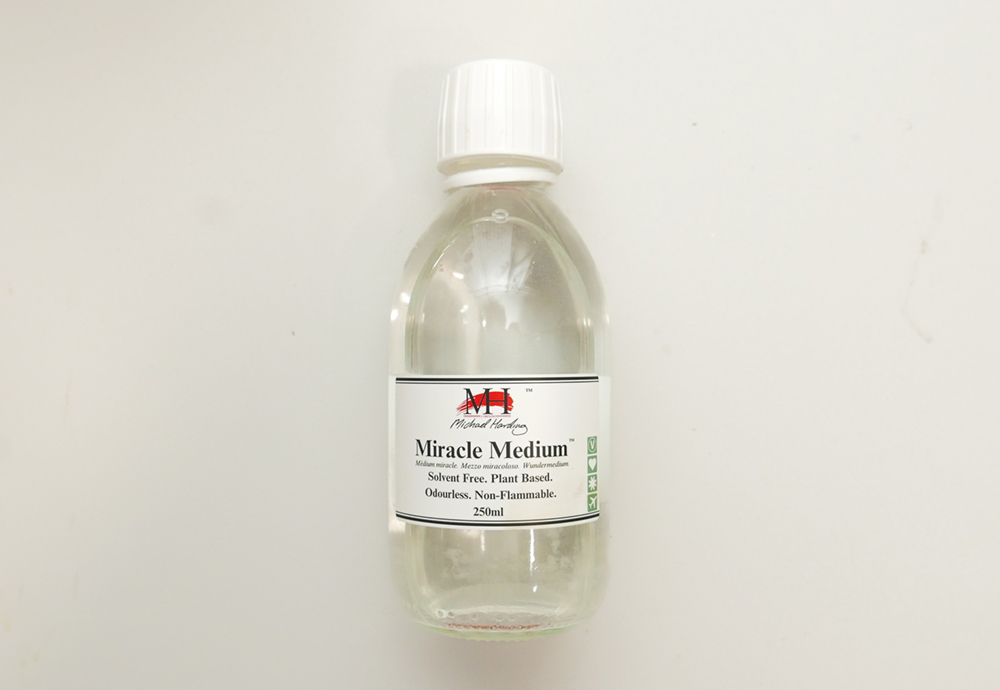
Michael Harding Miracle Medium for traditional oils
“Derived from renewable vegetable sources, the Miracle Medium™ range is odourless, solvent-free, and designed to provide a safer, cleaner studio environment”
An alternative to working solvent-free and non-toxic with traditional oils is to use Michael Harding’s Miracle Medium.
I often use this in the studio, and you only need to add a small amount to increase flow and dilute the paint. You don’t get the same dramatic colour shift from wet to dry as you do when thinning heavily with water.
The drawback of this medium is that the recommended ratio for adding to your traditional oil paints is only 5 to 10%. This means you can’t really achieve a thin consistency for underpainting as you could with Odourless Mineral Spirit.
Also, it takes longer to dry than using Odourless Mineral Spirit.

A solvent-free alternative to the medium W gel is solvent-free gel from Gamblin
You can also get solvent-free alternatives for traditional oil gels, like this one from Gamblin.
Can you use linseed oil with the Medium-W
No. The linseed oil will work against the water-mixability you’ve added with the gel/fluid.
Can I use water-mixable Linseed Oil with Medium-W
Yes, you can; the water-mixable linseed oil will mix well and is easier to clean when washed with water.
How do Water-mixable Oils compare?
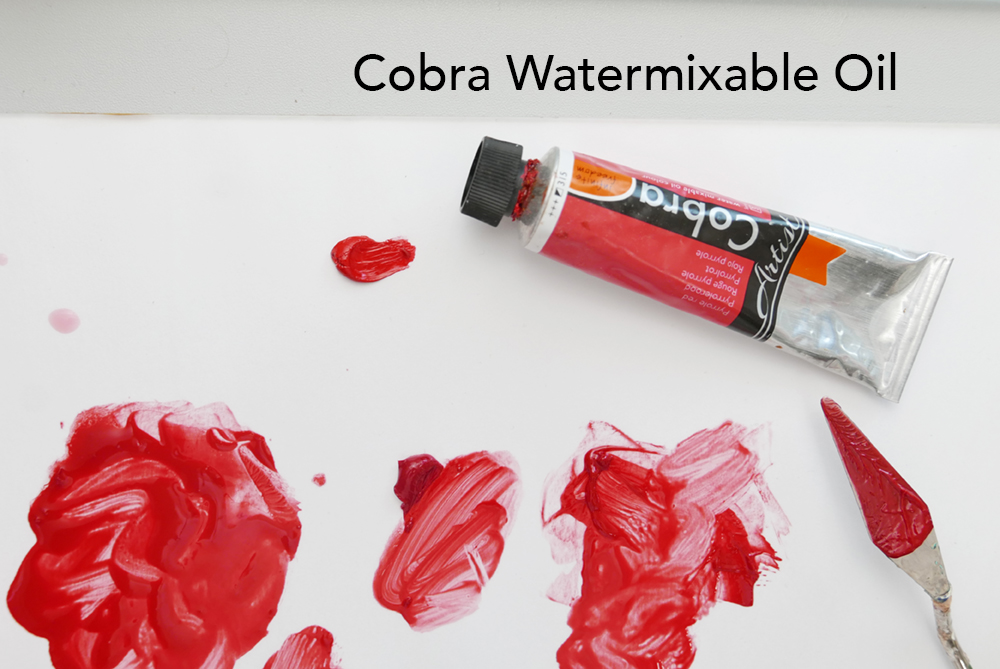
Here I’ve poured out a small amount of Pyrrole Red from Cobra water-mixable oils, and then I’m going to dilute it with a touch of water (about the same amount of OMS that I put in the first control dilution)
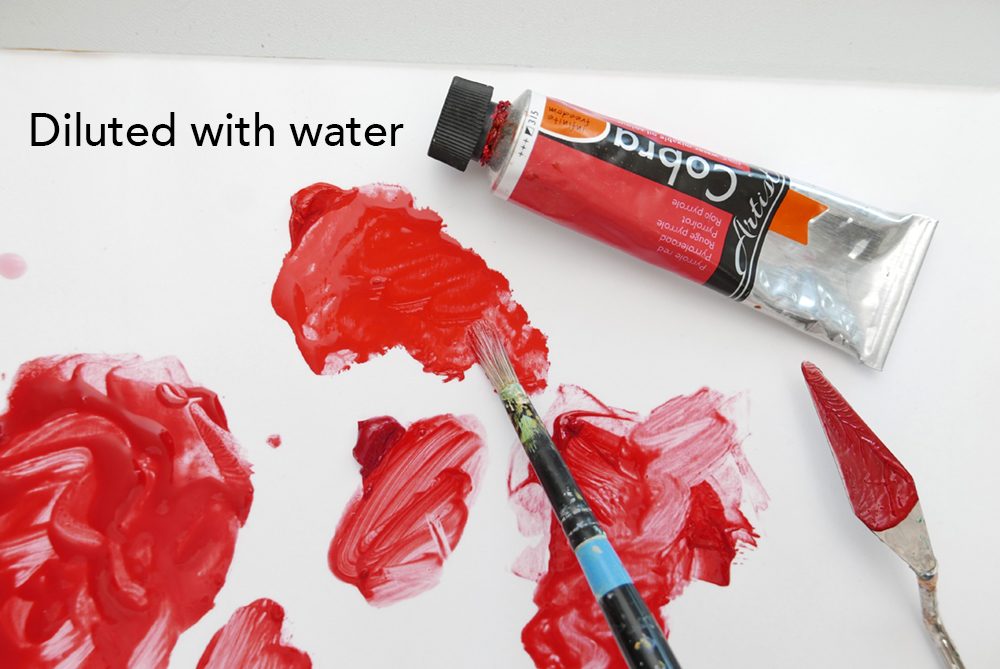
You can see the flowing paint, just diluted with a dash of water, and it’s got a nice even consistency. Personally, I much prefer using a water-mixable thinner or medium instead of water.
Thinning heavily with water can still introduce some of the wet-to-dry colour shift issues discussed earlier, so there are always a few technical variables to learn and work around.
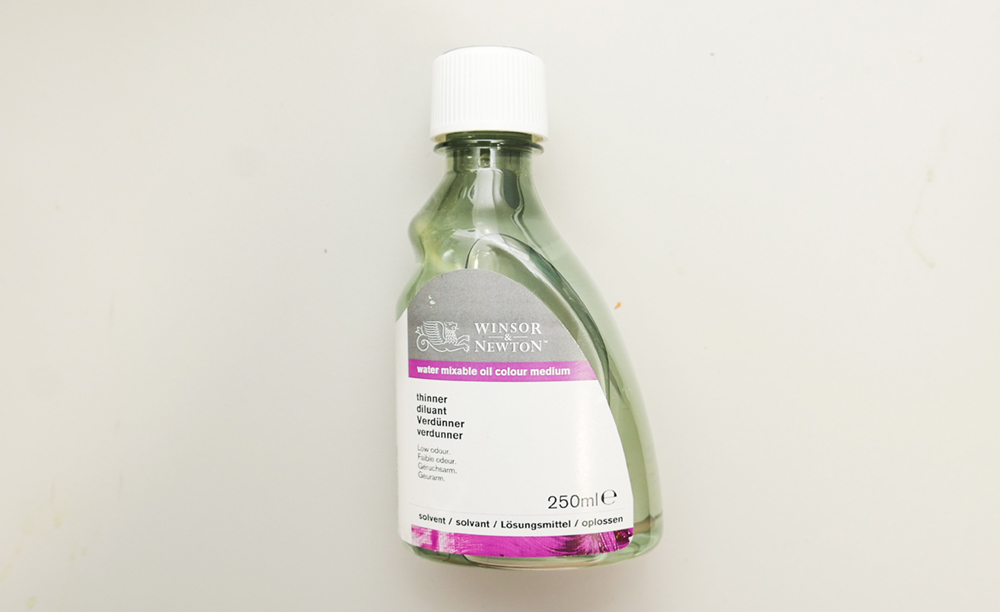
Winsor & Newton water mixable oils thinner. I often use this when working with water-mixable oils. Water is used for cleaning your brushes, but the thinner gives better flow control and feel when painting.
Would I Recommend Schmincke ‘Medium-W’ ?
Yes, in the right circumstances.
For certain situations, Medium-W can be super useful.
If you have an oil colour you love but can’t find in a water-mixable range, Medium-W can be a clever way to integrate that colour into your palette.
Also, if you’ve already got a studio full of expensive traditional oil paints, it might be worth experimenting with.
If you’re painting away from the studio and want a water-based cleanup, it can be great.
For fluid sketching and cleanup with water, Medium-W fluid provides flow without excessive solvent use. However, if your goal is to work with water as cleanup, I would recommend building your palette around water-mixable oil paints.
Cost Comparison: Medium W to Water-mixable Oils.
If you mix in the Medium W, this means that for every small squeeze of paint, you need to add half f as much fluid or gel medium.
When you scale that up across six or eight colours on your palette, you can end up using quite a lot of medium, which quickly adds to the cost.
- 40ml of the Medium W gel works out at around £9.49
- 40ml of Cobra Yellow Ochre water-mixable oil paint (an earth colour and one of the more affordable pigments) is around £6.70
- 40ml of Cobra Cadmium Yellow Deep is around £13.50.
If you’d like to explore these differences further, I have several free YouTube videos that compare water-mixable oils, traditional oils, mediums, and solvent-free approaches in greater depth.
Water-mixable Oils vs Traditional Oils
Differences between Acrylic and Oil Paint
Further training
And if you’d like a more structured introduction, I also have :
Beginner’s Water-Mixable Oil Painting Course
Beginner’s Traditional Oil Painting Course
Both are designed to guide you step-by-step through the materials, techniques, and painting process from the ground up.


Thanks for this explanation, Will. I use OMS and traditional oil paints. I always work in a well ventilated space, so I’m wondering how toxic the OMS is and should I be concerned about it?
Hey Lisa, OMS has had practically all of the aromatic hydrocarbons removed (Aromatics: Less than 0.005%) which are the most harmful components. This dramatically reduces both smell and toxicity. Traditional oils + OMS in a ventilated studio is low exposure. There is a safety data sheet (SDS) ON this page from Gamblin: https://gamblincolors.com/oil-painting/gamsol/
Will
Thanks Will for this well researched article.
I’ve just switched to water mixable oils.
I wanted the longer working time but actually was more concerned by the fact that acrylic paint created microplastics when flushed into the wastewater.
I know in the grand scheme of plastic pollution this is a small amount- it still feels plastic. I know you can find greener acrylics now too.
I recently bought a course from you but haven’t had the time to complete it. Thanks for sharing the usual in-depth quality of your work here. It’s really helpful.
Excellent article! You’ve answered virtually every question that has ever been raised but never fully answered on Medium W, it’s specific uses, and how it compares with water mixable paints. Crucially, you’ve included the cost of using this medium which would help in making informed decisions in terms of volume of usage. For me, the best use of Medium W would be for integrating my remaining oil colours with water-mixables so they don’t go to waste! Thanks for these valuable tips. Once again, you’ve demonstrated your unique talent in making complex topics accessible and easy to understand.
Cheers Lena
Hi Will, this is very timely for me. I am suffering from Mast Cell Activation Syndrome, an auto-immune disorder, that makes you highly sensitive to strong odors, chemicals and histamine. I would like to move away from oils and OMS/Galkyd as my doctor says the paints may be contributing, but found the water soluble oils way too intense (the smell). I might try using the Medium W. I did just purchase some of the M Graham oil paints which are said to have less intense smells, (and they do really seem odorless compared to my usual Gamblins and Winsor Newtons, but I have not painted with them yet) along with the Weber odorless turnpenoid, which is less pungent than OMS. I don’t want to go to acrylics; I started there and just love oil painting more!
Hey Kathleen,
The fluid Medium W does also have a smell I forgot to mention (the gel less so). With the M Graham paints, the main difference in the smell will be because traditional oils use linseed oil as their binder. Whereas M Graham uses walnut oil, so it doesn’t have that strong linseed smell to the paints.
Hi Will,
You frequently highlight awareness of harmful chemicals in paint products, and for that I’m grateful. I like to paint, so that means whatever I’m using I’m going to be exposed to repeatedly. So I avoid anything toxic … it’s not worth it. This information opens the world of traditional oils to me and that’s a great gift. Thanks for that. -Laura
As usual your explanation is both really helpful and clear. I so appreciate your generous teaching and am obviously not alone. Thank you!
Thanks Philippa
I have used these (and Cobra’s medium which also converts traditional oil to water miscible. And they usually work, but as Will points out, it does impact the hue of the color, sometimes just a little and sometimes a bit more. And when I tried it with Gamblins Flake White Equivalent, it turned into a very strange, unusable mess that bore little resemblance to the original product. (This was true for the Cobra mediums as well).
Oh interesting, I hadn’t come across the cobra version, thanks for the note.
Hi Will, Cobra by RT also has a medium mix you add to traditional oils to make them water-mixable. I purchased this product but have not used it yet.
Thanks Carrie, very much appreciated, I’ll have a look into it.
Thanks for this Will. How interesting. I have some W&N wmo thinner which really seems to be the thing. I don’t really like diluting with water. I also use the Cobra wmo painting medium to loosen wmo paint straight from the tube. I only use water to clean the brushes. But I still find regular oil paint and regular thinner/medium the nicest to use. Or Alkyd paints
Hey Roger, yes, the W&N WMO thinner is great.
Thank You Will…
I recently attempted my first painting using Water Mixable Oils. The painting process was greatly simplified: I simply used water to clean my brushes during and after painting, eliminating the odour of solvents. For thinning the paint, I used W&N Water Mixable thinner and W&N Water Mixable Linseed Oil.
However, at the very end, I resorted to using strong nail polish remover to clean my glass palette as the stuck-on paint wouldn’t come off easily with soap and water – which completely defeated the purpose of non-toxic WMOs haha! My room now smells of acetone !
I discovered that acetone removes stubborn paint residues much more quickly and easily than any solvent, from both oil and acrylic palettes. Am I breaking a rule? Will, pls advise. Thanks
You’re not breaking any rule at all.
The main advantage of Water Mixable Oils is that they reduce or eliminate your exposure to solvents during the painting process. It doesn’t necessarily mean you have to ban every solvent from the studio forever.
Acetone is a very powerful solvent and will dissolve dried paint residues much more quickly than odourless mineral spirits.
One thing you might find useful is a metal glass scraper. If you’re working on a glass palette, you can scrape away most of the dried paint before cleaning, which keeps the need for solvents to an absolute minimum.
Will
Thanks Will. Super helpful as always.
Hi Will,
Thanks for this interesting article! It’s great to see the photos from your experiments with this medium. How concerned should we be about the leftover pigment after painting with Medium W and cleaning the brush with water? Do you think it might ruin the brush over time? I wonder if a possible workaround might be to use water to clean brushes while painting, and then do one good OMS rinse at the end of the day. It should cut down on exposure quite a bit even if it doesn’t cut the OMS out entirely.
Hey Franny, ‘How concerned should we be about the leftover pigment after painting with Medium W and cleaning the brush with water?’ I wouldn’t be concerned, you would just need to use some paper towel to wipe off the paint from the bristles, The master’s brush cleaner can also be great for cleaning brushes. But, yes, having the water for washing brushes when painting would still work well, it’s just the final clean up. But I’ll often still use soap with traditional oils or water-mixbale oils for final clean up of the brushes.
Hi Will, I love reading all of your writings!! Thank-you for them!! I paint in Oils, and only use a bit of Poppy Seed Oil when needed. Just did a whole Sunflower painting, with no medium at all.
God bless, C-Marie
I’m writing to you from Colombia. I’d like to try oil painting, but my problem is the poorly ventilated space and the fact that I have two pets. I thought medium w was the solution because I bought traditional oil paints and didn’t want to waste them, but after reading your article, a question arises: if I start the first layers with medium w, can I finish painting with traditional oil paint straight from the tube?
Hi Dairon, yes you can.