The reason I’m creating this easy to follow, on-line video course is to help frustrated artists find a way to express themselves by drawing with confidence.
With over 3 hours of tuition from Will, you can go on a creative journey to discover that you can pick up a pencil, wherever, whenever and actually start drawing…
Perspective is one of the most common issues beginners have with drawing and painting.
Get it wrong and it can easily ruin a great start, get it right and it can instantly improve your work.
If you’re like most painters you are probably trying to create a sense of depth in your work.
Leading the viewer’s eye deep into the scene giving the illusion of reality.
But sometimes it just doesn’t look right.
The distant object doesn’t look so distant, your figures look out of proportion, a building looks like it is sliding off the page. And your still life just looks….odd.
Video Transcript – How to use the ‘rule of thirds’ in your landscape paintings
Morning class, today, we will have a quick look at the composition and the rule of thirds.
Even though it’s called a rule, it’s really just a guide to help you compose a picture that looks natural within a rectangle or square; I find it always works best, though, within a rectangle.
All you do is split your page into thirds, horizontally and vertically. And these bad boys on the intersections are what we’re looking for…these are what we can align key points of interest to pump up our paintings to guide the viewer into where we want them to look…
‘And after drawing comes composition. A well-composed painting is half done’
Pierre Bonnard
Imagine a lovely drawing of a house with a path meandering up to it, trees either side in careful balance, a classic landscape scene that just ‘works’.
Where is this masterpiece? The Tate? The National?
No, stuck to your fridge door, created by a 4-year-old.
As a young child, visual harmony and composition comes naturally.
Children seem to start out with a near perfect sense of composition if you have small children or are lucky enough to have any of your old drawings you created as a child I’m sure you’ll find the same to be true.
Younger children see the edges of the paper as a whole frame to fill, and they often fill them with a great sense of balance.
When you start to grow up, you know – really old like 9 or 10, that’s where the drawing problems start. The focus shifts and is aimed away from composition to the pursuit of something far more important, where the accolades are huge and respect even greater, the quest for the ultimate prize …… realism.
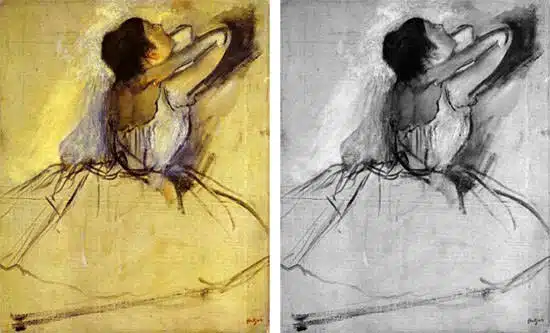
Contrast is really important when you’re starting to learn how to paint.
A good knowledge of contrast in drawing helps significantly because you will have learned the value of light and dark.
If you are coming from a non-drawing background, you will have to be more aware that to make a dramatic painting “contrast is king”, rather than trying to add a bright colour to lift the painting…