

Morning class, I’d like to introduce you to a new Acrylics Course.
Welcome to Vincent’s Sunflowers in Acrylics.
Over 4+ hours of tuition
This is a simple, easy-to-follow downloadable video course with over 4 hours of tuition.
It’s a one-time payment with lifetime access to the lessons.
The course is a self-study video course for beginners exploring Van Gogh’s palette, methods and techniques. It has been designed as a step-by-step, rounded learning experience that brings together all my knowledge as a student, painter, and teacher.
What’s in the Course?
- 1 x Van Gogh-inspired Sunflowers painting from start to finish, based in the studio, working from a reference image.
- 13-lesson curriculum: Downloadable Video Lessons (with lifetime access to these recordings)
- Step-by-step acrylic painting lessons that you can follow at your own pace.
- A clear, easy-to-follow process for building the painting in stages.
- A drawing template to help you overcome the blank canvas and get started with confidence.
- LIFETIME ACCESS to video lessons, download on separate devices, keep forever.
- Over 4+ hrs of detailed video instruction.
- (I demonstrate the course with acrylics, using gels and thicker paint to create texture, but you could also adapt the approach to water-mixable oils or traditional oils if you prefer.)
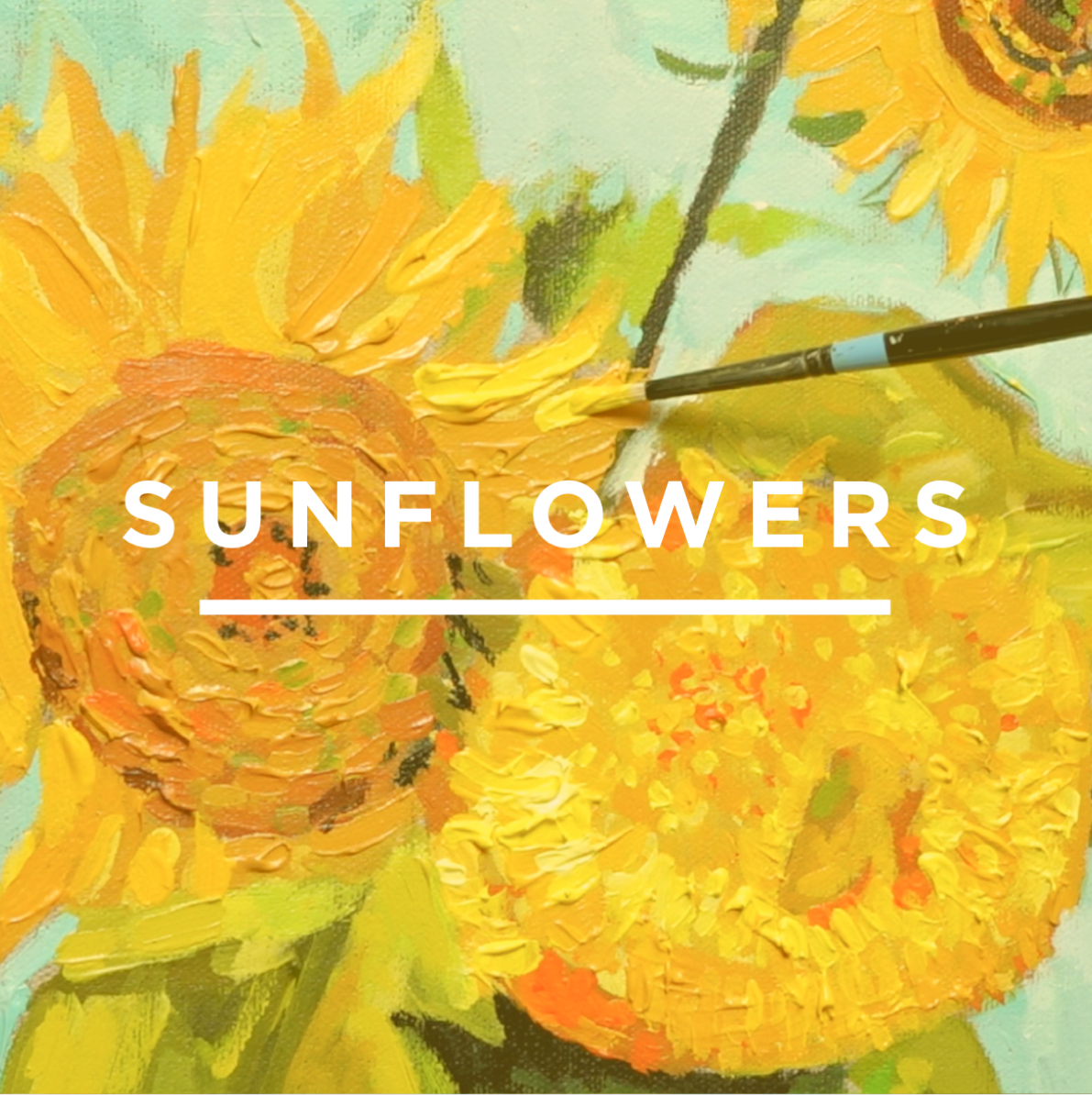
In this course, we’ll observe one of the most expressive painters in art history: Vincent van Gogh.
Best known for his bold use of colour, thick impasto brushwork, and paintings filled with emotion and movement, Van Gogh transformed simple subjects into something unforgettable.
And few subjects capture that better than his Sunflowers.
Van Gogh painted his Sunflowers series after moving to Arles in the South of France in 1888. It was a period of hope, ambition, uncertainty, and intense creative energy. He was searching for his own voice as an artist, and in these paintings we can see his brushwork becoming looser, his colour choices bolder, and his style more personal than ever before.
I’ve chosen this particular version of the Sunflowers, ‘Three Sunflowers in a Vase‘ because it beautifully captures the warmth, optimism, and intensity of that moment.
At first glance, it looks like a simple vase of flowers.
But when you look closer, there’s so much to learn.
Thick paint. Directional marks. Broken edges. Subtle yellows. Muted greens. A background that shifts and glows. Brushstrokes that don’t just describe the subject, they become part of the experience.
You’ll learn how to build a painting in stages, starting with a simple grid drawing and moving through the background, tabletop, vase, leaves, and sunflower heads.
We’ll look at how Van Gogh used colour relationships to create impact, how small areas of contrast can bring a painting to life, and how to use thicker acrylic paint and gels to suggest the texture and energy of impasto brushwork.
If you’re unsure of your drawing, no worries. We use a simple grid method to help keep everything in proportion and make the subject feel much more approachable.
And if you’ve ever looked at Van Gogh’s paintings and thought, “I’d love to paint with that kind of freedom, but I wouldn’t know where to start,” this course will guide you through it step by step.
So grab a brew, maybe a straw hat, and let’s paint Vincent’s Sunflowers!
Is this course for me?
“I’m not good enough.”
Van Gogh often felt the same way. He compared himself to other artists, questioned his abilities, and struggled to achieve what he saw in his mind. Yet he kept painting. Every brushstroke was a step forward.
“I’ve left it too late.”
Van Gogh didn’t dedicate himself fully to art until he was 27. Art doesn’t ask when you started. It asks whether you’re willing to start.
“What if I never develop my own style?”
Your style isn’t hiding somewhere waiting to be discovered. It grows through practice. Van Gogh’s famous Sunflowers weren’t the beginning of his journey. They were the result of years of observation, experimentation, and changing. The same process is available to every artist who is willing to pick up a brush and begin.
“I don’t know if I have talent.”
Talent is overrated. Before you write yourself off, ask yourself a different question: have you actually given yourself the chance to learn? Van Gogh certainly didn’t look like a genius when he started. His early drawings were awkward, his paintings were dark and heavy. Most people decide they don’t have talent long before they’ve given themselves enough time to improve.
This course isn’t about proving you’re talented. It’s about discovering what happens when you stop judging yourself and start painting.
You can join here: Vincent’s Sunflowers in Acrylics.