If you’re accustomed to painting with music or in silence, you’re not alone. Many artists find comfort in familiar sounds—or the absence of them as they create. But have you ever considered inviting a new kind of companion into your studio?
Why Listen to Art Podcasts as a Beginner (or Experienced Artist)?
As a beginner, it’s easy to assume you need to spend every moment learning a technique. But the truth is, the biggest hurdle for most new artists isn’t a lack of skill. It’s feeling motivated and confident that you’re on the right path.
That’s where podcasts shine.
They offer you the chance to hear from working artists, tutors, and creatives who have all been where you are now.
Listening to their stories, challenges, and painting methods can shift your mindset from “Am I doing this right?” to “I’m not alone, and I can keep going.”
What if confidence, not skill, is the key to your painting progress?
Most beginners struggle with acrylics because they’ve never been shown a simple, structured approach with progressive techniques.
My YouTube channel has helped over 300,000 artists get started, with more than 25 million views.
My speciality?
Helping students who believe they “can’t even draw a stick man” finish paintings they’re genuinely proud of.
The Secret: Progress Is a State of Confidence, Not Skill
If progress comes from building confidence rather than technical skill alone, how would that change your approach to learning?
I came across this idea recently when reading “Suddenly Talented’ by Sean D’Souza, and it struck a chord.
“When we talk about talent, we rush madly towards skill.Yet, there is no skill without confidence. Confidence makes the reluctant student realise that they’re not so bad after all.” Sean D’Souza – Suddenly Talented
I’ve found many beginners try to learn painting or drawing by osmosis, by watching an experienced artist work.
Before starting a larger painting, I almost always create a “postcard” colour study.
This small-scale version helps determine if the concept will work at a larger size and provides a roadmap for the painting process.
These simple studies allow you to plan composition, colour balance, and value structure before committing to your final piece. Solving problems at this manageable scale gives you confidence and clarity before investing time.
Think of this as a visual test lab for experimentation and discovery. Although painting the same subject twice may feel like a waste of time, the insights from a quick study help avoid frustrations that can emerge later on.
This week, I’ve been painting a small postcard study of a street scene in Mousehole on the Cornish Coast. It was a really grey day, full of a mizzle sky and lots of rain reflected on the road.
I liked how this view had dashes of yellow from the double yellow lines that had faded out. These matched the same colours as the hedge on the right-hand side.
There is some warmer orange yellow in the roof, and in the very far distance, just above the chimney, you can see the little cottages that go around the harbour. (You can see a sketch of the harbour towards the end of this article)
I read an article that said a pencil can write 35 miles.
35 miles! I’m sure that can’t be true.
But the idea got me thinking about how keen we are to judge our drawing efforts before we’ve had time to develop our skills.
Many people give up on drawing after just a few attempts, declaring, “I can’t draw” or “I have no natural talent.” way too early on in the actual drawing practice.
That’s like judging your fitness level after a week of walking around the block, so it’d be easy to do a couple of drawings that don’t quite work out.
Drawing, like any skill, takes time and practice to develop.
A method that can help is to look at a non-emotional record of progress. It can help you keep calm and not critically self-assess your work until you’ve done a much larger body of work.
In the beginner’s drawing course, I recommend hiding your first attempts in an envelope to look back on in the future.
When progress in developing any skill is incremental, it can be helpful to have clear times to have a check-in on how things are going and to look back and see what has improved.
35 miles is a lot of shading; that’s 1,000s of contours and a bucket load of erasers!
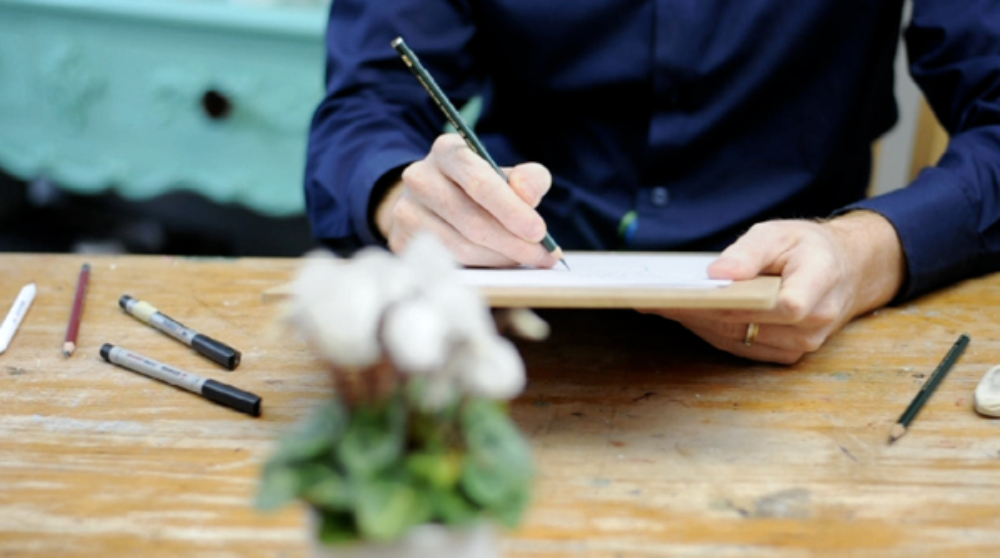
I’ve been focusing on portrait structure, and anatomy with pencil on paper.
Morning Sketches from Jan 2025
Morning Sketches from Jan 2025
Morning Sketches from Jan 2025
There’s a whole story and a whole journey that would have come out of one pencil.
Not only do I remember the sketches that went well, but lots of smudging, erasing and relooking. I also remember how the sun was streaming in through the studio window when I sat down to do the third sketch and the croissant I was going to buy after my practice.
If you’re drawing with pen and ink, put a little pot on the side for empty ink cartridges.
Keep a bin for used-up paint tubes – not to judge the work but to celebrate a dedication to practice. I think it’s a nice idea just to think in terms of evidence; every artist’s journey is made up of these small records.
Ready to start your own artistic journey? My Absolute Beginners Drawing Course is designed specifically for people who think they “can’t draw.” Through proven techniques, you’ll discover that anyone can learn to draw – including you.
True freedom lies in consciously choosing what matters most and letting go of the rest. For overthinkers, this can feel impossible.
The Reality Check
Eight days into the new year, my paints and sketchpad are still on the shelf.
Things have been “busy.”
You know how it goes: catching up on YouTube videos, checking my macros, meeting friends. But in the back of my mind, I’ve been thinking about what I want to make next… a lot.
Some would call it overthinking.
The list of things I want to do grows endless: Sargent-inspired portraits, still life studies with just a biro, square landscape paintings of Cornwall, epic wide-angle views of Scotland, and a new watercolour course.
I procrastinate, and before I’ve even begun, I have lost some momentum in executing these ‘amazing’ ideas.
Understanding Resistance
In Steven Pressfield’s “The War of Art,” he talks about ‘resistance’ – that mysterious force that stops us from doing what we should be doing. Every creative experiences it. As Pressfield writes:
“Fear tells us what we have to do. Remember our rule of thumb: The more scared we are of a work or calling, the more sure we can be that we have to do it. Resistance is experienced as fear; the degree of fear equates to the strength of Resistance.” – Steven Pressfield, the War of Art
Understanding that happiness, contentment, and calm come from overcoming resistance helps you take steps to work through it.
The Overthinking Trap
I tend to get stuck in the weeds – I analyse framing options before drawing the first line, think about international shipping fees before getting my first order, and research every camera and printer option on the market before deciding which painting to turn into a print.
These tendencies can be fantastic for idea generation or interdisciplinary thinking, but what they’re not so good at is a focus.
The (self-inflicted) pressure to ‘specialize’ can mean it’s easier not to paint anything for fear of painting the wrong thing.
A Solution: Pick One
Here’s my proposal for a personal New Year creative experiment, and I invite you to try it yourself:
Pick one.
Just one format, one medium, one subject.
The key is knowing that you’re not abandoning all other ideas – they’re just waiting their turn. This might feel a little uncomfortable as your ego jumps in to say, ‘You could do more’.
When you’re painting, the goal is an appreciation for those fleeting moments of pure creation.
Sometimes, the bravest thing we can do is to simply begin.
If you’re looking for a course that has one image, one path, you might enjoy the following single project courses:
One of the most common messages I receive, is from beginners, asking if they ‘need to loosen up.’
Sometimes they do, sometimes they don’t.
Painting in a loose, impressionistic style has the allure of freedom and artistic and personal expression. But when you’re thinking about your drawing, composition, and colour mixing, achieving fluid and expressive brushwork feels elusive.
So, what can you do to practice? How can you keep a balance between realism and looseness?
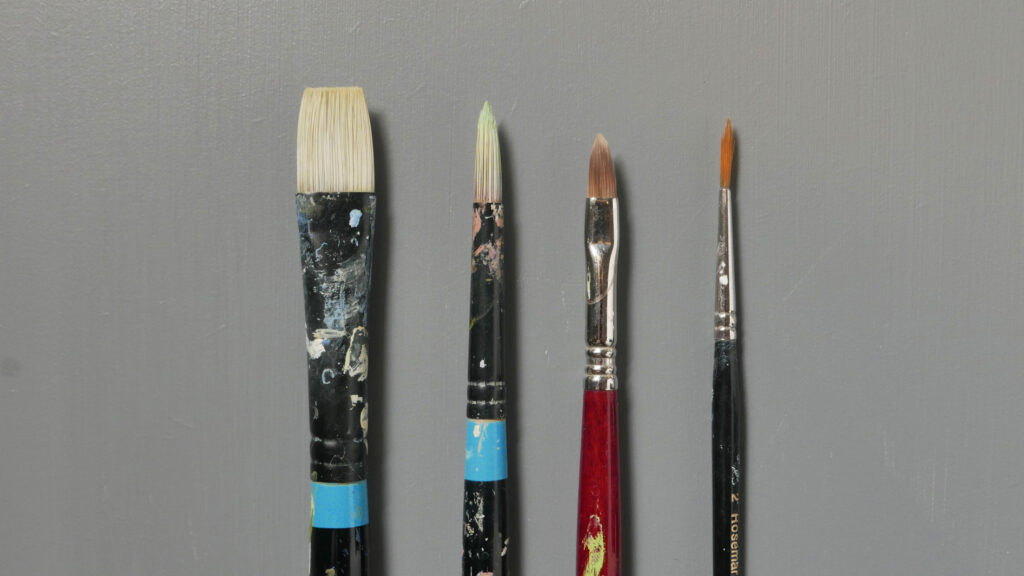
The key to looser brushwork lies in mastering the subtleties of your tools and learning how to let go of unnecessary precision.
There is nothing more daunting to a beginner artist than the question, “How much do you charge?”
Putting a price on your artwork can make your stomach drop, trigger imposter syndrome, and cause you to get flustered.
The idea of selling your work can sometimes lead to giving your paintings away for free, convincing yourself that the ‘exposure’ will bring future commissions.
With this in mind, I wanted to share my experiences with the emotions that can hold you back, the factors that influence the value of your art, and how to develop a pricing strategy. Hopefully, this will give you the clarity and confidence you need so you’ll be prepared the next time someone asks about your prices!
(The Wetting Agent was previously called ‘Acrylic Flow Release’)
I find using a stay-wet palette really helpful when my acrylics dry too quickly in the studio.
I’ll often premix colours on a tear-off palette and transfer the paint piles into a stay-wet palette. It acts as a loading bay where I can keep my acrylic mixes workable for a few days.
I’ve just finished making my NEW acrylic still life painting course, whoo hoo!
This time, the subject is a single-stem peony inspired by its layers of ruffled petals and delicate colour palette. I’m running a launch-week offer!
You might feel intimidated by the complexity of painting peonies, struggle with basic drawing techniques, lack confidence in your colour-mixing skills, or are unsure of how to start.
Don’t worry; I’ve got you covered!
This is a self-paced, downloadable video course. I’m excited to guide you through creating the delicate details of a peony in an impressionist style.
I demonstrate this with acrylics, but you can easily follow along with water-mixable oils or traditional oils.
Last week, we explored Carlson’s theory on angles, and I received an interesting comment from a reader asking how complicated it would be to apply the principles to colour.
“I especially love black and white painting. I’m looking forward to trying this. How does it work then with colour? Seems it could get quite complicated.” – Laura
Well, it’s simpler than you might think!
I thought it would be handy to demonstrate painting trees using just four colour mixes. I’m using water-mixable oils, but you can follow along with acrylics or traditional oils too.
As a beginner landscape painter, it’s easy to feel overwhelmed by the vastness of nature and the complexity of capturing it on canvas. But when you break down the scene into shapes, values and planes, you can instantly improve the sense of depth and realism.
In last week’s post, we looked at the theory of angles and how they relate to a landscape.
This week, we’re going to put the theory into practice.
By stripping away the colour, it will be easier to see how the value relationships work in our subject.
Materials you will need:
4 x 4-inch or 6 x 6-inch square canvas board or canvas paper